Tuesday, 8 July 2025
SLiMSuite Servers out of action
Following a move out of academia and lack of ongoing funding, the SLiMSuite website and servers at UNSW are currently out of action. It is not clear at this point whether they will be restored, replaced, or permanently retired. SLiMSuite programs and code are still available from GitHub. Please get in touch if you have any questions during this transition period.

Thursday, 19 September 2024
SLiMSuite Release v1.12.0 (2024-09-19)


The current SLiMSuite release is v1.12.0 (2024-09-19) and can be downloaded by clicking the button (left).
In addition to the tarball available via the button (left), SLiMSuite is now available as a GitHub repository (right).

See also: Installation and Setup.
The main updates in SLiMSuite v1.12.0 are:
- Python3. The main tools in use have been updated and checked with Python3. Some older tools might still have bugs.
- BUSCOMP now has a new mode
phylofas=Tto generate output of compiled and renamed files for BUSCO-based phylogenomics. - DepthKopy has undergone several upgrades and will now rate Duplicated BUSCOs (TRUE/FALSE) based on depth, chunk up input for multithreaded processing, and collapse features by depth to estimate total copy number. KAT can now generate the kmer usage in an alternative assembly for comparison.
- DepthSizer has some miscellaneous bug fixes and the same parallisation added to DepthKopy.
- Diploidocus output has been updated for ChromSyn compatibility.
- NUMTFinder has had several coverage and depth bugs fixed.
- PAFScaff has been updated for rapid BUSCO-based mapping. Added
purechrom=Tto enable reciprocal PAFScaff runs for SharpClaw - SynBad has received multiple updates to enable BUSCO mapping and update the assembly map output to be compatible with Telociraptor.
- Telociraptor has received multiple updates to improve generation of tweaked assemblies from assembly maps. It also now features a chromosome sorting and renaming function based on size.
- DepthCharge has a new
minspan=INTminimum spanning bp at end of reads (trims from PAF alignments). - ChromSyn has undergone numerous updates and improvement: see the ChromSyn github for details.
NOTE: Several tools are now maintained and updated more regularly in their own GitHub repos.
Wednesday, 12 January 2022
SLiMSuite release v1.11.0 (2022-01-12)

SLiMSuite v1.11 sees the introduction of six genome assembly tools:
- DepthCharge = Genome assembly quality control and misassembly repair. DepthCharge is an assembly quality control and misassembly repair program. It uses mapped long read depth of coverage to charge through a genome assembly and identify coverage “cliffs” that may indicate a misassembly. If appropriate, it will then blast the assembly into fragment at those misassemblies.
- DepthKopy = DepthKopy: Read-depth based copy number estimation. DepthKopy applies the same single-copy read depth estimate as DepthSizer to estimate the copy number of different gene regions in a slightly modified version of the approach used in the basenji genome paper.
- DepthSizer = DepthSizer: Read-depth based genome size prediction. DepthSizer uses long-read depth profiles and BUSCO single-copy orthologues to predict genome size. DepthSizer works on the principle that Complete BUSCO genes should represent predominantly single copy (diploid read depth) regions along with some poor quality and/or repeat regions. Assembly artefacts and collapsed repeats etc. are predicted to deviate from diploid read depth in an inconsistent manner. Therefore, even if less than half the region is actually diploid coverage, the modal read depth is expected to represent the actual single copy read depth.
- GapSpanner = GapSpanner: Genome assembly gap long read support and reassembly tool. GapSpanner uses (or generates) a BAM file of long reads mapped to a genome assembly to assess assembly “gaps” for spanning read support. Optionally, reads spanning each gap can be extracted and re-assembled with Flye. If the new assembly spans the gap, crude gap-filling can be performed. This will be reversed if edits are not subsequently supported by spanning reads mapped onto the updated assembly.
- NUMTFinder = NUMTFinder: Nuclear mitochondrial fragment (NUMT) search tool. NUMTFinder uses a mitochondrial genome to search against genome assembly and identify putative NUMTs. NUMT fragments are then combined into NUMT blocks based on proximity.
- Taxolotl = Taxolotl: Genome assembly taxonomy summary and assessment tool. Taxolotl combines the MMseqs2 easy-taxonomy with GFF parsing to perform taxonomic analysis of a genome assembly (and any subsets given by taxsubsets=LIST) using an annotated proteome. Taxonomic assignments are mapped onto genes as well as assembly scaffolds and (if assembly=FILE is given) contigs.
Documentation for these tools can be found in their individual repos. Please note that individual repos may be ahead of the main SLiMSuite repo.
More information can also be found in the corresponding publications:
- Chen SH, Rossetto M, van der Merwe M, Lu-Irving P, Yap JS, Sauquet H, Bourke G, Amos TG, Bragg JG & Edwards RJ (accepted): Chromosome-level de novo genome assembly of Telopea speciosissima (New South Wales waratah) using long-reads, linked-reads and Hi-C. Molecular Ecology Resources. [Mol Ecol Res] [bioRxiv]
- Edwards RJ, Field MA, Ferguson JM, Dudchenko O, Keilwagen K, Rosen BD, Johnson GS, Rice ES, Hillier L, Hammond JM, Towarnicki SG, Omer A, Khan R, Skvortsova K, Bogdanovic O, Zammit RA, Aiden EL, Warren WC & Ballard JWO (2021): Chromosome-length genome assembly and structural variations of the primal Basenji dog (Canis lupus familiaris) genome. BMC Genomics 22:188 [BMC Genomics] [PubMed] [bioRxiv]
- Stuart KC*, Edwards RJ*, Cheng Y, Warren WC, Burt DW, Sherwin WB, Hofmeister NR, Werner SJ, Ball GF, Bateson M, Brandley MC, Buchanan KL, Cassey P, Clayton DF, De Meyer T, Meddle SL & Rollins LA (preprint): Transcript- and annotation-guided genome assembly of the European starling. bioRxiv 2021.04.07.438753; doi: 10.1101/2021.04.07.438753. [*Joint first authors] [bioRxiv]
See also the included release_notes.txt on GitHub for a full list of the python module updates since v1.9.0.
Monday, 11 October 2021
BUSCOMP v0.13.0 (MetaEuk) release
BUSCOMP v0.13.0 is now on GitHub. This release features updates to parse additional BUSCO v5 outputs, including transcriptome and proteome mode. It has also been updated to be compatible with MetaEuk runs by generating the missing *.fna files where possible.
The citation remains:
Stuart KC, Edwards RJ, Cheng Y, Warren WC, Burt DW, Sherwin WB, Hofmeister NR, Werner SJ, Ball GF, Bateson M, Brandley MC, Buchanan KL, Cassey P, Clayton DF, De Meyer T, Meddle SL, Rollins LA (preprint): Transcript- and annotation-guided genome assembly of the European starling. bioRxiv 2021.04.07.438753; doi: 10.1101/2021.04.07.438753. [*Joint first authors]
DepthSizer v1.4.0 (IndelRatio) release
DepthSizer v1.4.0 has been released on GitHub. DepthSizer is a program to estimate genome size from an assembly, long-read sequencing data, and BUSCO single-copy orthologue predictions.
DepthSizer works on the principle that Complete BUSCO genes should represent predominantly single copy (diploid read depth) regions along with some poor quality and/or repeat regions. Assembly artefacts and collapsed repeats etc. are predicted to deviate from diploid read depth in an inconsistent manner. Therefore, even if less than half the region is actually diploid coverage, the modal read depth is expected to represent the actual single copy read depth.
This release features an extensive reworking under the hood, which moves the main calculation into R and smooths the read depth modal density calculation. Some of the older, less accurate, approaches have been dropped in favour of some additional mapping adjustments that aim to frame the upper and lower bounds of genome size.
Current citation:
Chen SH, Rossetto M, van der Merwe M, Lu-Irving P, Yap JS, Sauquet H, Bourke G, Bragg JG & Edwards RJ (preprint): Chromosome-level de novo genome assembly of Telopea speciosissima (New South Wales waratah) using long-reads, linked-reads and Hi-C. bioRxiv 2021.06.02.444084; doi: 10.1101/2021.06.02.444084.
Sunday, 27 December 2020
SLiMSuite release v1.9.1 (2020-12-27)
SLiMSuite release v1.9.1 (2020-12-27) is now on GitHub and Zenodo:
- Edwards RJ (2020): SLiMSuite v1.9.1 (2020-12-27). Zenodo DOI: 10.5281/zenodo.3229523
SLiMSuite v1.9 sees the introduction of four genome assembly tools:
- Diploidocus = Diploid genome assembly analysis toolkit. Includes assembly cleanup (haplotig/artefact removal), genome size prediction and read depth copy number analysis.
- PAFScaff = Pairwise mApping Format reference-based scaffold anchoring and super-scaffolding. Uses minimap2 to map a genome assembly onto reference chromosomes.
- SAAGA = Summarise, Annotate & Assess Genome Annotations. Uses a reference proteome to summarise and assess genome annotations.
- SynBad = Synteny-based scaffolding adjustment tool for comparing two related genome assemblies and identify putative translocations and inversions between the two that correspond to gap positions. (Development only.)
There have also been significant updates to:
- BUSCOMP = BUSCO Compiler and Comparison tool. Used for genome assembly completeness estimates that are robust to sequence quality, and for compiling BUSCO results.
Other changes include some initial reformatting for Python3 compatibility. This is ongoing work; please report any odd behaviour.
See the included release_notes.txt for a full list of the python module updates since v1.8.1.
NOTE: At time of posting, the REST servers have not yet been updated with the latest version. This will happen soon.
Monday, 27 May 2019
SLiMSuite release v1.8.1 (2019-05-27)
SLiMSuite release v1.8.1 (2019-05-27) is now on GitHub and Zenodo:
- Edwards RJ (2019): SLiMSuite v1.8.1 (2019-05-27). Zenodo DOI: 10.5281/zenodo.3229523
This update has fast-forwarded the SLiMSuite release to v1.8.1 to be consistent with the tools/slimsuite.py wrapper script. A top level SLiMSuite.py file can now be run to access the main tools and functions of the package. The REST servers have also been updated to run this version of the code.
This release of SLiMSuite contains a number of updates related to the REST servers and some new tools, notably SAMPhaser long read diploid phasing algorithm, and BUSCOMP BUSCO compiler and comparison tool. See release notes (below) for more details.
SLiMSuite updates
Updates in extras/:
• rje_pydocs: Updated from Version 2.16.7.
→ Version 2.16.8: Updated to to parse https.
→ Version 2.16.9: Tweaked docstring parsing.
Updates in libraries/:
• rje: Updated from Version 4.19.0.
→ Version 4.19.1: Added code for catching non-ASCII log filenames.
→ Version 4.20.0: Added quiet mode to log object and output of errors to stderr. Fixed rankList(unique=True)
→ Version 4.21.0: Added hashlib MD% functions.
→ Version 4.21.1: Fixed bug where silent=T wasn't running silent.
• rje_blast_V2: Updated from Version 2.22.2.
→ Version 2.23.3: Fixed LocalIDCut error for GABLAM and QAssemble stat filtering.
• rje_db: Updated from Version 1.9.0.
→ Version 1.9.1: Updated logging of adding/removing fields: default is now when debugging only.
• rje_disorder: Updated from Version 1.2.0.
→ Version 1.3.0: Switched default behaviour to be md5acc=T.
→ Version 1.4.0: Fixed up disorder=parse and disorder=foldindex.
→ Version 1.5.0: Added iupred2 and anchor2 parsing from URL using accnum. Made default disorder=iushort2.
• rje_genbank: Updated from Version 1.5.3.
→ Version 1.5.4: Added recognition of *.gbff for genbank files.
• rje_obj: Updated from Version 2.2.2.
→ Version 2.3.0: Added quiet mode to object and stderr output.
→ Version 2.4.0: Added vLog() and bugLog() methods.
→ Version 2.4.1: Fixed bug where silent=T wasn't running silent.
• rje_paf: Created/Renamed/moved.
→ Version 0.0.0: Initial Compilation.
→ Version 0.1.0: Initial working version. Compatible with GABLAM v2.30.0 and Snapper v1.7.0.
→ Version 0.2.0: Added endextend=X : Extend minimap2 hits to end of sequence if with X bp [10]
→ Version 0.3.0: Added mapsplice mode for dealing with transcript mapping.
→ Version 0.3.1: Correct PAF splicing bug.
→ Version 0.4.0: Added TmpDir and forking for GABLAM conversion.
→ Version 0.5.0: Added uniquehit=T/F : Option to use *.hitunique.tdt table of unique coverage for GABLAM coverage stats [False]
• rje_ppi: Updated from Version 2.8.1.
→ Version 2.9.0: Added ppiout=FILE : Save pairwise PPI file following processing (if rest=None) [None]
• rje_qsub: Updated from Version 1.9.2.
→ Version 1.9.3: Updates the order of the qsub -S /bin/bash flag.
• rje_rmd: Created/Renamed/moved.
→ Version 0.0.0: Initial Compilation.
• rje_samtools: Updated from Version 1.20.0.
→ Version 1.20.1: Fixed mlen bug. Added catching of unmapped reads in SAM file. Fixed RLen bug. Changed softclip defaults.
→ Version 1.20.2: Fixed readlen coverage bug and acut bug.
• rje_seq: Updated from Version 3.25.0.
→ Version 3.25.1: Fixed -long_seqids retrieval bug.
→ Version 3.25.2: Fixed 9spec filtering bug.
• rje_seqlist: Updated from Version 1.29.0.
→ Version 1.30.0: Updated and improved DNA2Protein.
→ Version 1.31.0: Added genecounter to rename option for use with other programs, e.g. PAGSAT.
→ Version 1.31.1: Fixed edit bug when not in DNA mode.
→ Version 1.32.0: Added genomesize and NG50/LG50 to DNA summarise.
→ Version 1.32.1: Fixed LG50/L50 bug.
• rje_sequence: Updated from Version 2.6.0.
→ Version 2.7.0: Added shift=X to maskRegion() for 1-L input. Fixed cterminal maskRegion.
• rje_slimcore: Updated from Version 2.9.0.
→ Version 2.10.0: Added seqfilter=T/F : Whether to apply sequence filtering options (goodX, badX etc.) to input [False]
→ Version 2.10.1: Fixed default results file bug.
→ Version 2.10.2: Improved handling and REST output of disorder scores.
→ Version 2.11.0: Modified qregion=X,Y to be 1-L numbering.
• rje_slimlist: Updated from Version 1.7.3.
→ Version 1.7.4: Modified concetanation of SLiMSuite results to use "|" in place of "#" for better compatibility.
• rje_uniprot: Updated from Version 3.25.0.
→ Version 3.25.1: Fixed proteome download bug following Uniprot changes.
→ Version 3.25.2: Fixed Uniprot protein extraction issues by using curl. (May not be a robust fix!)
Updates in tools/:
• buscomp: Created/Renamed/moved.
→ Version 0.0.0: Initial Compilation.
→ Version 0.1.0: Basic working version.
→ Version 0.2.0: Functional version with basic RMarkdown HTML output.
→ Version 0.3.0: Added ratefas=FILELIST: Additional fasta files of assemblies to rate with BUSCOMPSeq (No BUSCO run) [].
→ Version 0.4.0: Implemented forking and tidied up output a little.
→ Version 0.5.0: Updated genome stats and RMarkdown HTML output. Reorganised assembly loading and proeccessing. Added menus.
→ Version 0.5.1: Reorganised code for clearer flow and documentation. Unique and missing BUSCO output added.
→ Version 0.5.2: Dropped paircomp method and added Rmarkdown control methods. Updated Rmarkdown descriptions. Updated log output.
→ Version 0.5.3: Tweaked log output and fixed a few minor bugs.
→ Version 0.5.4: Deleted some excess code and tweaked BUSCO percentage plot outputs.
→ Version 0.5.5: Fixed minlocid bug and cleared up minimap temp directories. Added LnnIDxx to BUSCOMP outputs.
→ Version 0.5.6: Added uniquehit=T/F : Option to use *.hitunique.tdt table of unique coverage for GABLAM coverage stats [False]
→ Version 0.6.0: Added more minimap options, changed defaults and dev generation of a table changes in ratings from BUSCO to BUSCOMP.
→ Version 0.6.1: Fixed bug that was including Duplicated sequences in the buscomp.fasta file. Added option to exclude from BUSCOMPSeq compilation.
→ Version 0.6.2: Fixed bug introduced that had broken manual group review/editing.
→ Version 0.7.0: Updated the defaults in the light of test analyses. Tweaked Rmd report.
→ Version 0.7.1: Fixed unique group count bug when some genomes are not in a group. Fixed running with non-standard options.
→ Version 0.7.2: Added loadsummary=T/F option to regenerate summaries and fixed bugs running without BUSCO results.
• comparimotif_V3: Updated from Version 3.13.0.
→ Version 3.14.0: Modified memsaver mode to take different input formats.
• gablam: Updated from Version 2.29.0.
→ Version 2.30.0: Added mapper=X : Program to use for mapping files against each other (blast/minimap) [blast]
→ Version 2.30.1: Fixed BLAST LocalIDCut error for GABLAM and QAssemble stat filtering.
• gopher: Updated from Version 3.4.3.
→ Version 3.5.0: Added separate outputs for trees with different alignment programs.
→ Version 3.5.1: Added capacity to run DNA GOPHER with tblastx. (Not tested!)
→ Version 3.5.2: Added acc=LIST as alias for uniprotid=LIST and updated docstring for REST to make it clear that rest=X needed.
• haqesac: Updated from Version 1.12.0.
→ Version 1.13.0: Modified qregion=X,Y to be 1-L numbering.
• pagsat: Updated from Version 2.4.0.
→ Version 2.5.0: Reduced the executed code when mapfas=T assessment=F. (Recommended first run.) Added renaming.
→ Version 2.5.1: Added recognition of *.gbff for genbank files.
→ Version 2.6.0: Added mapper=X : Program to use for mapping files against each other (blast/minimap) [blast]
→ Version 2.6.1: Switch failure to find key report files to a long warning, not program exit.
→ Version 2.6.2: Fixed bugs with mapper=minimap mode and started adding more internal documentation.
→ Version 2.6.3: Fixed default behaviour to run report=T mode.
→ Version 2.6.4: Fixed summary table merge bug.
→ Version 2.6.5: Fixed compile path bug.
→ Version 2.6.6: Fixed BLAST LocalIDCut error for GABLAM and QAssemble stat filtering.
→ Version 2.6.7: Generalised compile path bug fix.
→ Version 2.6.8: Added ChromXcov fields to PAGSAT Compare.
• pingu_V4: Updated from Version 4.9.0.
→ Version 4.9.1: Fixed Pairwise parsing and filtering for more flexibility of input. Fixed fasid=X bug and ppiseqfile names.
→ Version 4.10.0: Added hubfield and spokefield options for parsing hublist.
• qslimfinder: Updated from Version 2.2.0.
→ Version 2.3.0: Modified qregion=X,Y to be 1-L numbering.
• samphaser: Created/Renamed/moved.
→ Version 0.0.0: Initial Compilation.
→ Version 0.1.0: Updated SAMPhaser to be more memory efficient.
→ Version 0.2.0: Added reading of sequence and generation of SNP-altered haplotype blocks.
→ Version 0.2.1: Fixed bug in which zero-phasing sequences were being excluded from blocks output.
→ Version 0.3.0: Made a new unzip process.
→ Version 0.4.0: Added RGraphics for unzip.
→ Version 0.4.1: Fixed MeanX bug in devUnzip.
→ Version 0.4.2: Made phaseindels=F by default: mononucleotide indel errors will probably add phasing noise. Fixed basefile R bug.
→ Version 0.4.3: Fixed bug introduced by adding depthplot code. Fixed phaseindels bug. (Wasn't working!)
→ Version 0.4.4: Modified mincut=X to adjust for samtools V1.12.0.
→ Version 0.4.5: Updated for modified RJE_SAMTools output.
→ Version 0.4.6: splitzero=X : Whether to split haplotigs at zero-coverage regions of X+ bp (-1 = no split) [100]
→ Version 0.5.0: snptable=T/F : Output filtered alleles to SNP Table [False]
→ Version 0.6.0: Converted haplotig naming to be consistent for PAGSAT generation. Updated for rje_samtools v1.21.1.
→ Version 0.7.0: Added skiploci=LIST and phaseloci=LIST : Optional list of loci to skip phasing []
→ Version 0.8.0: poordepth=T/F : Whether to include reads with poor track probability in haplotig depth plots (random track) [False]
• seqmapper: Updated from Version 2.2.0.
→ Version 2.3.0: Added GABLAM-free method.
• seqsuite: Updated from Version 1.19.1.
→ Version 1.20.0: Added rje_paf.PAF.
→ Version 1.21.0: Added NG50 and LG50 to batch summarise.
→ Version 1.22.0: Added BUSCOMP to programs.
→ Version 1.23.0: Added rje_ppi.PPI to programs.
• slimbench: Updated from Version 2.18.2.
→ Version 2.18.3: Added better handling of motifs without TP occurrences for OccBench. Added minocctp=INT.
→ Version 2.18.4: Fixed ELMBench rating bug.
→ Version 2.18.5: Fixed Balanced=F bug.
→ Version 2.19.0: Implemented dataset=LIST: List of headers to split dataset into. If blank, will use datatype defaults. []
• slimfarmer: Updated from Version 1.9.0.
→ Version 1.10.0: Added appending contents of jobini file to slimsuite=F farm commands.
• slimfinder: Updated from Version 5.3.4.
→ Version 5.3.5: Fixed slimcheck and advanced stats models bug.
→ Version 5.4.0: Modified qregion=X,Y to be 1-L numbering.
• slimparser: Updated from Version 0.5.0.
→ Version 0.5.1: Minor docs and bug fixes.
→ Version 0.6.0: Improved functionality as replacement pureapi with rest=jobid and rest=check functions.
• slimsuite: Updated from Version 1.7.1.
→ Version 1.8.0: Added BUSCOMP and basic test function.
→ Version 1.8.1: Updated documentation and added IUPred2. General tidy up and new example data for protocols paper.
• smrtscape: Updated from Version 2.2.2.
→ Version 2.2.3: Fixed bug where SMRT subreads are not returned by seqlist in correct order. Fixed RQ=0 bug.
• snapper: Updated from Version 1.6.1.
→ Version 1.7.0: Added mapper=minimap setting, compatible with GABLAM v2.30.0 and rje_paf v0.1.0.
© RJ Edwards 2019. Last modified 27 May 2019.
Monday, 2 July 2018
SLiMSuite Downloads
UPDATE: Please see the Downloads page for the most recent release.
The current SLiMSuite release is v1.4.0 (2018-07-02) and can be downloaded by clicking the button (left).
In addition to the tarball available via the links above, SLiMSuite is available as a GitHub repository (right).
See also: Installation and Setup.
Previous Releases
v1.3.0 (2017-12-18)v1.2.0 (2016-09-12)v1.1.0 (2015-11-30)2015-06-01v1.0.0 (2015-01-07)
SLiMSuite release v1.4.0 (2018-06-02) now oline
SLiMSuite release v1.4.0 (2018-07-02) is now on GitHub. The REST servers have also been updated to run this version of the code.
This release of SLiMSuite contains a number of updates related to the REST servers and some new pre-release dev tools in the main repo (but not the *.tgz file).
SeqList has updated sequence summary statistics and grep-based redundancy removal for large genomes.
One major bug fix is a change to parsing Uniprot entries from the website following a change in behaviour of the API.
SLiMSuite updates
Updates in extras/:
• rje_pydocs: Updated from Version 2.16.3.
→ Version 2.16.4: Tweaked formatDocString.
→ Version 2.16.5: Added general commands to docstring HTML for REST servers.
→ Version 2.16.6: Modified parsing to keep DocString for SPyDarm runs.
→ Version 2.16.7: Fixed T/F/FILE option type parsing bug.
Updates in libraries/:
• rje_blast_V2: Updated from Version 2.18.0.
→ Version 2.19.0: Added blastgz=T/F : Whether to zip and unzip BLAST results files [False]
→ Version 2.19.1: Fixed erroneous i=-1 blastprog over-ride but not sure why it was happening.
→ Version 2.20.0: Added localGFF output
→ Version 2.21.0: Added blasttask=X setting for BLAST -task ['megablast']
→ Version 2.22.0: Added dust filter for blastn and setting blastprog based on blasttask
→ Version 2.22.1: Added trimLocal error catching for exonerate issues.
→ Version 2.22.2: Fixed GFF attribute case issue.
• rje_db: Updated from Version 1.8.6.
→ Version 1.9.0: Added comment output to saveToFile().
• rje_disorder: Updated from Version 0.8.
→ Version 1.0.0: Added random disorder function and elevated to v1.x as fully functional for SLiMSuite
→ Version 1.1.0: Added strict option for disorder method selection. Added minorder=X.
→ Version 1.2.0: Added saving and loading scores to IUScoreDir/.
• rje_gff: Created/Renamed/moved.
→ Version 0.0.0: Initial Compilation.
→ Version 0.1.0: Basic functional version.
• rje_hpc: Updated from Version 1.1.
→ Version 1.1.1: Added output of subjob command to log as run.
• rje_html: Updated from Version 0.2.1.
→ Version 0.3.0: Added optional loading of javascript files and stupidtable.js?dev default.
• rje_qsub: Updated from Version 1.9.1.
→ Version 1.9.2: Modified qsub() to return job ID.
• rje_samtools: Updated from Version 1.19.2.
→ Version 1.20.0: Added parsing of BAM file - needs samtools on system. Added minsoftclip=X, maxsoftclip=X and minreadlen=X.
• rje_seq: Updated from Version 3.24.0.
→ Version 3.25.0: 9spec=T/F : Whether to treat 9XXXX species codes as actual species (generally higher taxa) [False]
• rje_seqlist: Updated from Version 1.25.0.
→ Version 1.26.0: Updated sequence statistics and fixed N50 underestimation bug.
→ Version 1.26.1: Fixed median length overestimation bug.
→ Version 1.26.2: Fixed sizesort bug. (Now big to small as advertised.)
→ Version 1.27.0: Added grepNR() method (dev only). Switched default to RevCompNR=T.
→ Version 1.28.0: Fixed second pass NR naming bug and added option to switch off altogether.
→ Version 1.29.0: Added maker=T/F : Whether to extract MAKER2 statistics (AED, eAED, QI) from sequence names [False]
• rje_slimcalc: Updated from Version 0.9.3.
→ Version 0.10.0: Added extra disorder methods to slimcalc.
• rje_taxonomy: Updated from Version 1.2.0.
→ Version 1.3.0: taxtable=T/F : Whether to output results in a table rather than text lists [False]
• rje_tree: Updated from Version 2.15.0.
→ Version 2.16.0: 9spec=T/F : Whether to treat 9XXXX species codes as actual species (generally higher taxa) [False]
→ Version 2.16.1: Modified NSF reading to cope with extra information beyond the ";".
• rje_uniprot: Updated from Version 3.24.1.
→ Version 3.24.2: Updated HTTP to HTTPS. Having some download issues with server failures.
→ Version 3.25.0: Fixed new Uniprot batch query URL. Added onebyone=T/F : Whether to download one entry at a time. Slower but should maintain order [False].
• rje_zen: Updated from Version 1.3.2.
→ Version 1.4.0: Added some more words and "They fight crime!" structure.
Updates in tools/:
• gablam: Updated from Version 2.28.3.
→ Version 2.29.0: Added localGFF=T/F output
• gasp: Updated from Version 1.4.
→ Version 2.0.0: Upgraded to rje_obj framework for REST server.
• gasp_V1: Created/Renamed/moved.
→ Version 0.0: Initial Compilation.
→ Version 1.0: Improved version with second pass.
→ Version 1.1: Improved OO. Restriction to descendant AAs. (Good for BAD etc.)
→ Version 1.2: No Out Object in Objects
→ Version 1.3: Added more interactive load options
→ Version 1.4: Minor tweaks to imports.
• gopher: Updated from Version 3.4.2.
→ Version 3.4.3: Added checking and warning if no bootstraps for orthtree.
• haqesac: Updated from Version 1.11.0.
→ Version 1.12.0: 9spec=T/F : Whether to treat 9XXXX species codes as actual species (generally higher taxa) [False]
• multihaq: Updated from Version 1.3.0.
→ Version 1.4.0: Added SLiMFarmer batch forking if autoskip=F and i=-1.
→ Version 1.4.1: Added haqblastdir=PATH: Directory in which MultiHAQ BLAST2FAS BLAST runs will be performed [./HAQBLAST/]
• pagsat: Updated from Version 2.3.3.
→ Version 2.3.4: Fixed full.fas request bug.
→ Version 2.4.0: Added PAGSAT compile mode to generate comparisons of reference chromosomes across assemblies.
• seqsuite: Updated from Version 1.14.0.
→ Version 1.14.1: Added zentest for testing the REST servers.
→ Version 1.15.0: Added GASP to REST servers.
→ Version 1.16.0: Add rje_gff.GFF to REST servers.
→ Version 1.17.0: Added batch summarise mode.
→ Version 1.18.0: Added rje_apollo.Apollo to REST servers.
→ Version 1.19.0: Tweaked the output of batch summarise, adding Gap% and reducing dp for some fields.
→ Version 1.19.1: Fixed GapPC summarise output to be a percentage, not a fraction.
• slimbench: Updated from Version 2.14.0.
→ Version 2.14.1: Fixed up PPIBench results loading.
→ Version 2.14.2: Fixed ByCloud bug.
→ Version 2.15.0: Updated assessSearchMemSaver() to handle different data types properly. dombench not yet supported.
→ Version 2.16.0: Added ppi hub/slim summary and motif filter for assessment datasets post-rating (still count as OT)
→ Version 2.16.1: Bug-fixing PPI generation from pairwise PPI files.
→ Version 2.16.2: Fixed benchmarking setup bug.
→ Version 2.16.3: Fixed bug when Hub-PPI links fail during PPI Benchmarking.
→ Version 2.17.0: Added output of missing datasets when balanced=T.
→ Version 2.18.0: Added dev OccBench with improved ratings and more efficient results handling. (dev only)
→ Version 2.18.1: Added additional OccBench options (bymotif, occsource, occspec)
→ Version 2.18.2: Fixed problem with source file selection ignoring i=-1.
• slimfarmer: Updated from Version 1.7.0.
→ Version 1.8.0: jobforks=X : Number of forks to pass to farmed out run if >0 [0]
→ Version 1.9.0: daisychain=X : Chain together a set of qsub runs of the same call that depend on the previous job.
• slimfinder: Updated from Version 5.3.3.
→ Version 5.3.4: Fixed terminal (^/$) musthave bug.
• slimsuite: Updated from Version 1.7.0.
→ Version 1.7.1: Added error raising for protected REST alias data.
• smrtscape: Updated from Version 2.2.1.
→ Version 2.2.2: Added dna=T to all SeqList object generation.
• snapper: Updated from Version 1.6.0.
→ Version 1.6.1: Fixed bug for reducing to unique-unique pairings that was over-filtering.
© RJ Edwards 2018. Last modified 2 Jul 2018.
Tuesday, 16 January 2018
SLiMSuite REST server is back up
The REST server is back up. The development server is currently having an upgrade and should not be used.
SLiMSuite REST server is currently down
The SLiMSuite REST server is experiencing some technical difficulties at the moment. It will hopefully be back up soon.
Tuesday, 19 December 2017
SLiMSuite REST Servers updated
The SLiMSuite REST Servers have been updated to the latest release code (v1.3.0). Please report any issues!
SLiMSuite release v1.3.0 (2017-12-18) online
SLiMSuite release v1.3.0 (2017-12-18) is now on GitHub. Funding for SLiMSuite development is proving elusive at present, so this release is a little less organised (and later) than planned. The main additions are various programs in development for PacBio genomics and a draft SLiMSuite parser Shiny app in the new shiny/ directory. The old packages/ directory has also been removed. Check the docs/release/ files and see below for more information on this release.
Another release with improved documentation is currently planned for early 2018. As ever, if you want access to the latest code, email to download the full svn repository.
SLiMSuite updates
Updates in extras/:
• rje_dbase: Updated from Version 2.3.
→ Version 2.3.1: Updated the dbdownload function to recognise individual files and wildcard file lists.
• rje_pydocs: Updated from Version 2.16.3.
→ Version 2.17.4: Tweaked formatDocString.
→ Version 2.17.5: Added general commands to docstring HTML for REST servers.
Updates in legacy/:
Updates in libraries/:
• rje: Updated from Version 4.17.0.
→ Version 4.18.0: Added Roman numeral functions.
→ Version 4.18.1: Updated error handling for full REST output.
→ Version 4.18.2: Fixed rje module call bug.
→ Version 4.19.0: Tweaked Docstring. Added extra parameter catching. Added report of INI loading.
• rje_blast_V2: Updated from Version 2.11.2.
→ Version 2.12.0: Added localidcut %identity filter for GABLAM calculations.
→ Version 2.13.0: Added GFF and SAM output for BLAST local tables for GABLAM, PAGSAT etc.
→ Version 2.14.0: Updated gablamfrag=X and fragmerge=X usage. Fixed localFragFas position output.
→ Version 2.15.0: Fragmerge no longer removes flanks and can be negative for enforced overlap!
→ Version 2.16.0: Added qassemblefas mode for generating fasta file from outfmt 4 run.
→ Version 2.16.1: Improved error messages for BLAST QAssembly.
→ Version 2.17.0: qconsensus=X : Whether to convert QAssemble alignments to consensus sequences (None/Hit/Full) [None]
→ Version 2.17.1: Modified QAssembleFas output sequence names for better combining of hits. Added QFasDir.
→ Version 2.17.2: Modified QAssembleFas output file names for better re-running. Fixed major QConsensus Bug.
→ Version 2.18.0: Added REST output. Fixed QConsensus=Full bug.
• rje_db: Updated from Version 1.8.1.
→ Version 1.8.2: Fixed minor readSet bug.
→ Version 1.8.3: Minor debugging message changes.
→ Version 1.8.4: Cosmetic log message changes.
→ Version 1.8.5: Added saveToFileName() function.
→ Version 1.8.6: Minor IndexReport tweak.
• rje_genbank: Updated from Version 1.5.2.
→ Version 1.5.3: Fixed https genbank download issue.
• rje_menu: Updated from Version 0.4.0.
→ Version 0.5.0: Enabled simpler return tuples.
• rje_obj: Updated from Version 2.2.1.
→ Version 2.2.2: Updated error handling for full REST output.
• rje_qsub: Updated from Version 1.6.3.
→ Version 1.7.0: Added option for email when job started
→ Version 1.8.0: Added modpurge=T/F : Whether to purge loaded modules in qsub job file prior to loading [True]
→ Version 1.9.0: Added precall=LIST : List of additional commands to run between module loading and program call []
→ Version 1.9.1: Removed default module list: causing conflicts. Better to have in INI file.
• rje_samtools: Updated from Version 1.8.1.
→ Version 1.9.0: Added depthplot data generation. (Will need to add R function for plot itself.)
→ Version 1.9.1: Changed mincut default to 0.1.
→ Version 1.10.0: Added readlen output, which is like the depth plot but uses max read length (kb) instead of depth.
→ Version 1.11.0: Added dirnlen=X : Include directional read length data at X bp intervals (depthplot=T; 0=OFF) [500]
→ Version 1.11.1: Minor tweaks to try and speed up pileup parsing.
→ Version 1.12.0: Updated the snpfreq run code to make clearer and check for parsing issues. Set mincut=1 default.
→ Version 1.13.0: Added skiploci=LIST - need to screen out mitochondrion from Illumina Pileup parsing!
→ Version 1.14.0: Added forking of pileup parsing for SNPFreq analysis.
→ Version 1.14.1: Fixed SNPFreq rerunning bug.
→ Version 1.15.0: Added rgraphics=T/F : Whether to generate snpfreq multichromosome plots [True]
→ Version 1.16.0: Add coverage calculation per locus to depth plot table output (depthplot=T).
→ Version 1.16.1: Added reporting of existing files for parsing Pileup.
→ Version 1.17.0: Added parsing of lengths from SAM files to RID file.
→ Version 1.18.0: Updated processing of Treatment and Control without Alt to still limit to SNPTable. Fixed SNPFreq filters.
→ Version 1.19.0: snptableout=T/F : Output filtered alleles to SNP Table [False]
→ Version 1.19.1: Fixed AltLocus SNP table bug.
→ Version 1.19.2: Updated forker parsing to hopefully fix bug.
• rje_seqlist: Updated from Version 1.20.1.
→ Version 1.21.0: Added capacity to add/update database object from self.summarise() even if not seqmode=db. Added filedb mode.
→ Version 1.22.0: Added geneDic() method.
→ Version 1.23.0: Added seqSequence() method.
→ Version 1.24.0: Add NNN gaps option and "delete rest of sequences" to edit().
→ Version 1.24.1: Minor edit bug fix and DNA toggle option.
→ Version 1.25.0: Added loading of FASTQ files in seqmode=file mode.
• rje_sequence: Updated from Version 2.5.3.
→ Version 2.6.0: Added mutation dictionary to Ks calculation.
• rje_slim: Updated from Version 1.12.0.
→ Version 1.12.1: Modified error message.
• rje_slimcalc: Updated from Version 0.9.2.
→ Version 0.9.3: Changed fudge error to warning.
• rje_slimcore: Updated from Version 2.7.7.
→ Version 2.7.8: Fixed batch=FILE error for single input files.
→ Version 2.8.0: Added map and failed output to REST servers and standalone uniprotid=LIST input runs.
→ Version 2.8.1: Updated resfile to be set by basefile if no resfile=X setting given
→ Version 2.9.0: Added separate IUPred long suffix for reusing predictions
• rje_synteny: Updated from Version 0.0.0.
→ Version 0.0.1: Altered problematic ValueError to warnLog()
→ Version 0.0.2: Updated the synteny mappings to be m::n instead of m:n for Excel compatibility.
→ Version 0.0.3: Added catching of the Feature locus/accnum mismatch issue.
• rje_tree: Updated from Version 2.14.0.
→ Version 2.14.1: Fixed clustalw2 makeTree issue.
→ Version 2.15.0: Added IQTree.
• rje_uniprot: Updated from Version 3.22.0.
→ Version 3.23.0: Added accnum map table output. Fixed REST output bug when bad IDs given. Added version and about output.
→ Version 3.24.0: Added pfam out and changed map table headers.
→ Version 3.24.1: Fixed process Uniprot error when uniprot=FILE given.
• rje_zen: Updated from Version 1.3.1.
→ Version 1.3.2: Added some more words.
• snp_mapper: Updated from Version 1.0.0.
→ Version 1.1.0: Added pNS and modified the "Positive" CDS rating to be pNS < 0.05.
→ Version 1.1.1: Updated pNS calculation to include EXT mutations and substitution frequency.
→ Version 1.2.0: SNPByFType=T/F : Whether to output mapped SNPs by feature type (before FTBest filtering) [False]
Updates in tools/:
• gablam: Updated from Version 2.23.0.
→ Version 2.23.1: Added tuplekeys=T to cmd_list as default. (Can still be over-ridden if it breaks things!)
→ Version 2.24.0: Added localidmin and and localidcut as %identity versions of localmin and localcut. (Use for PAGSAT.)
→ Version 2.25.0: Added localsAM=T/F : Save local (and unique) hits data as SAM files in addition to TDT [False]
→ Version 2.26.0: Fixed fragfas output and clarified fullblast=T/F, localmin=X and localcut=X. Set fullblast=T keepblast=T.
→ Version 2.26.1: Fixed keepblast error.
→ Version 2.26.2: Fixed gablamcut fragfas filtering bug.
→ Version 2.26.3: Fixed nrseq=T to use Query OR Hit stat for NR filtering.
→ Version 2.26.4: Minor bug fix to nrchoice command parsing.
→ Version 2.27.0: Fragmerge no longer removes flanks and can be negative for enforced overlap!
→ Version 2.28.0: Added localidmin=PERC to localUnique (and thus Snapper).
→ Version 2.28.1: Fixed missing combinedfas when using existing blastres.
→ Version 2.28.2: Minor bug fix for NRSeq manual choice when i=-1.
→ Version 2.28.3: Fixed NRSeq query sorting bug.
• haqesac: Updated from Version 1.10.2.
→ Version 1.10.3: Added catching of bad query when i=-1.
→ Version 1.11.0: Added resdir=PATH [./HAQESAC/] for d>0 outputs.
• multihaq: Updated from Version 1.2.2.
→ Version 1.3.0: MultiCut : Restrict BLAST to the top X hits from each database [100]
• pagsat: Updated from Version 1.11.2.
→ Version 1.11.3: Added reference=FILE as alias for refgenome=FILE. Fixed orphan delete bug.
→ Version 1.12.0: Tidying up and documenting outputs. Changed default minloclen=250 and minlocid=95. (LTR identification.)
→ Version 2.0.0: Major overhaul of outputs to improve consistency and clarity. Added Snapper to main run.
→ Version 2.1.0: Added localSAM output.
→ Version 2.1.1: Fixed the case of some output files.
→ Version 2.1.2: Fixed some issues with reverse hits in Snapper and application of minlocid.
→ Version 2.2.0: Added mapout=T, which is recommended for first run if going to subsequently tidy. (Run tidy on mapfile.)
→ Version 2.2.1: Tried to fix covplot bug in compare=FILES mode.
→ Version 2.2.2: Cleaned up *.map.* output for SAMPhaser output files. Added tidy/mapfas option selection.
→ Version 2.2.3: Added #NOTE to tidy and fixed makesnp=T bug.
→ Version 2.2.4: Fixed `fragrevcomp=F` bug for Gene and Protein TopHits.
→ Version 2.2.5: Hopefully really fixed makesnp=T bug now!
→ Version 2.2.6: Fixed Haploid tidy sequence output naming bug.
→ Version 2.2.7: Fixed Compare File path bug & dropped some empty outputs.
→ Version 2.3.0: Minor bug fixes and extra tidy options (join gaps and multi-deletes).
→ Version 2.3.1: Minor bug fixes.
→ Version 2.3.2: Updated the synteny mappings to be m::n instead of m:n for Excel compatibility.
→ Version 2.3.3: Fixed bad assembly sequence name bug.
• pagsat_V1: Created/Renamed/moved.
→ Version 1.0.0: Initial working version for based on rje_pacbio assessment=T.
→ Version 1.1.0: Fixed bug with gene and protein summary data. Removed gene/protein reciprocal searches. Added compare mode.
→ Version 1.1.1: Added PAGSAT output directory for tidiness!
→ Version 1.1.2: Renamed the PacBio class PAGSAT.
→ Version 1.2.0: Tidied up output directories. Added QV filter and Top Gene/Protein hits output.
→ Version 1.2.1: Added casefilter=T/F : Whether to filter leading/trailing lower case (low QV) sequences [True]
→ Version 1.3.0: Added tophitbuffer=X and initial synteny analysis for keeping best reference hits.
→ Version 1.4.0: Added chrom-v-contig alignment files along with *.ordered.fas.
→ Version 1.4.1: Made default chromalign=T.
→ Version 1.4.2: Fixed casefilter=F.
→ Version 1.5.0: diploid=T/F : Whether to treat assembly as a diploid [False]
→ Version 1.6.0: mincontiglen=X : Minimum contig length to retain in assembly [1000]
→ Version 1.6.1: Added diploid=T/F to R PNG call.
→ Version 1.7.0: Added tidy=T/F option. (Development)
→ Version 1.7.1: Updated tidy=T/F to include initial assembly.
→ Version 1.7.2: Fixed some bugs introduced by changing gablam fragment output.
→ Version 1.7.3: Added circularise sequence generation.
→ Version 1.8.0: Added orphan processing and non-chr naming of Reference.
&r
Friday, 28 July 2017
Edwards Lab: The SLiMEnrich Shiny App is now live
Edwards Lab: The SLiMEnrich Shiny App is now live: Sobia ’s first Shiny App is now up and running for final pre-publication testing on our new EdwardsLab RShiny server. See post for details.
Sunday, 5 March 2017
Problem with SLiMFinder bioware webserver
There is currently a problem with the SLiMFinder webserver hosted at UCD, where masking is failing to be performed, regardless of settings. This severely impacts the quality of results. (Disorder, low complexity and n-terminal methionine masking are generally recommended for SLiMFinder.)
I am in communication with the Shields lab to try and get the issue fixed but, until it has been rectified, the bioware.ucd.ie SLiMFinder webserver should not be used.
If you wish to run SLiMFinder online, you can do so via the SLiMFinder REST server (see BioInfoSummer 2016 workshop), which can also be run from within Cytoscape using the SLiMScape App.
Friday, 27 January 2017
SLiMSuite species codes
SLiMSuite species codes are designed to follow the UniprotKB organism (species) identification codes,
using them wherever possible. They form part of the standard gene_SPECIES__AccNum naming convention for sequences within
SLiMSuite. Species codes should be upper case, and unique for each species.
Tuesday, 11 October 2016
Odd blog behaviour
For some reason, the Download blog page is not working properly. Until rectified, please check the downloads tag if a link to SLiMSuite downloads breaks.
Update: this should be fixed now!
Monday, 12 September 2016
SLiMSuite release v1.2.0 (2016-09-12) online
The long-overdue September 2016 release of SLiMSuite 2016-09-12 - v1.2.0 is now on GitHub. Apart from a few bug fixes, the main updates in this release are to the tools for PacBio genomics, notably PAGSAT, SMRTSCAPE and a new SNP Mapping tool, Snapper. These are still in development and need further documentation but are ready for use with a little help. Please get in touch if you are interested. Proper documentation and example use will hopefully follow soon, as the first PacBio yeast paper is written.
GABLAM has had some minor tweaks for improved function with Snapper, PAGSAT and another developmental tool that will be in the next release (REVERT - available via the REST servers). These have been focused on the fragfas=T output of fragmented BLAST hits based on local alignments. This includes addition of a new default to reverse complement reverse hits (fragrevcomp=T) and the separation of parameters for splitting up local hits into multiple fragments (gablamfrag=X) and merging close/overlapping fragments (fragmerge=X).
SLiMSuite updates in this release
Updates in extras/:
• rje_pydocs: Updated from Version 2.16.2.
→ Version 2.16.3: Fixed docstring REST parsing to work with _V* modules.
Updates in libraries/:
• rje: Updated from Version 4.15.1.
→ Version 4.16.0: Added list2dict(inlist,inkeys) and dict2list(indict,inkeys) functions.
→ Version 4.16.1: Improved handling of integer parameters when given bad commands.
→ Version 4.17.0: Added extra functions to randomList()
• rje_blast_V2: Updated from Version 2.9.1.
→ Version 2.10.0: Added nocoverage calculation based on local alignment table.
→ Version 2.11.0: Added localFragFas output method.
→ Version 2.11.1: Fixed snp local table revcomp bug. [Check this!]
→ Version 2.11.2: Fixed GABLAM calculation bug when '*' in protein sequences.
• rje_db: Updated from Version 1.8.0.
→ Version 1.8.1: Added sfdict to saveTable output.
• rje_genbank: Updated from Version 1.3.2.
→ Version 1.4.0: Added addtags=T/F : Add locus_tag identifiers if missing - needed for gene/cds/prot fasta output [False]
→ Version 1.4.1: Fixed genetic code warning.
→ Version 1.5.0: Added setupRefGenome() method based on PAGSAT code.
→ Version 1.5.1: Fixed logskip append locus sequence file bug.
→ Version 1.5.2: Fixed addtag(s) bug.
• rje_hprd: Updated from Version 1.2.
→ Version 1.2.1: Fixed "PROTEIN_ARCHITECTURE" bug.
• rje_menu: Updated from Version 0.3.
→ Version 0.4.0: Changed handling of default for exiting menu loop. May affect behaviour of some existing menus.
• rje_mitab: Updated from Version 0.2.0.
→ Version 0.2.1: Fixed redundant evidence/itype bug (primarily dip)
• rje_obj: Updated from Version 2.1.3.
→ Version 2.2.0: Added screenwrap=X.
→ Version 2.2.1: Improved handling of integer parameters when given bad commands.
• rje_samtools: Updated from Version 0.1.0.
→ Version 0.2.0: Added majmut=T/F : Whether to restrict output and stats to positions with non-reference Major Allele [False]
→ Version 1.0.0: Major reworking. Old version frozen as rje_samtools_V0.
→ Version 1.1.0: Added snptabmap=X,Y alternative SNPTable mapping and read_depth statistics []. Added majref=T/F.
→ Version 1.2.0: Added developmental combining of read mapping onto two different genomes.
→ Version 1.3.0: Major debugging and code clean up.
→ Version 1.4.0: Added parsing of read number (to link SNPs) and fixed deletion error at same time. Added rid=T/F and snponly=T/F.
→ Version 1.5.0: Added biallelic=T/F : Whether to restrict SNPs to pure biallelic SNPs (two alleles meeting mincut) [False]
→ Version 1.5.1: Fixed REF/Ref ALT/Alt bug.
→ Version 1.6.0: Added majfocus=T/F : Whether the focus is on Major Alleles (True) or Mutant/Reference Alleles (False) [True]
→ Version 1.7.0: Added parsing of *.sam files for generating RID table.
→ Version 1.8.0: Added read coverage summary/checks.
→ Version 1.8.1: Fixed issue when RID file not generated by pileup parsing. Set RID=True by default to avoid issues.
• rje_samtools_V0: Created/Renamed/moved.
→ Version 0.0: Initial Compilation.
→ Version 0.1.0: Modified version to handle multiple loci per file. (Original was for single bacterial chromosomes.)
→ Version 0.2.0: Added majmut=T/F : Whether to restrict output and stats to positions with non-reference Major Allele [False]
• rje_seq: Updated from Version 3.23.0.
→ Version 3.24.0: Added REST seqout output.
• rje_seqlist: Updated from Version 1.15.3.
→ Version 1.15.4: Fixed REST server output bug.
→ Version 1.15.5: Fixed reformat=fasta default issue introduced from fixing REST output bug.
→ Version 1.16.0: Added edit=T sequence edit mode upon loading (will switch seqmode=list).
→ Version 1.17.0: Added additional summarise=T output for seqmode=db.
→ Version 1.18.0: Added revcomp to reformat options.
→ Version 1.19.0: Added option log description for deleting sequence during edit.
→ Version 1.20.0: Added option to give a file of changes for edit mode.
→ Version 1.20.1: Fixed edit=FILE deletion bug.
• rje_sequence: Updated from Version 2.5.2.
→ Version 2.5.3: Fixed genetic code warning error.
• rje_slimcore: Updated from Version 2.7.5.
→ Version 2.7.6: Added feature masking log info or warning.
→ Version 2.7.7: Switched feature masking OFF by default to give consistent Uniprot versus FASTA behaviour.
• rje_synteny: Created/Renamed/moved.
→ Version 0.0.0: Initial Compilation.
• rje_taxonomy: Updated from Version 1.1.0.
→ Version 1.2.0: Added storage of Parents.
• rje_tree: Updated from Version 2.13.0.
→ Version 2.14.0: Added cladeSpec().
• rje_uniprot: Updated from Version 3.21.4.
→ Version 3.22.0: Tweaked REST table output.
• rje_xref: Updated from Version 1.8.0.
→ Version 1.8.1: Added rest run mode to avoid XRef table output if no gene ID list is given. Added `genes` and `genelist` as `idlist=LIST` synonym.
→ Version 1.8.2: Catching self.dict['Mapping'] error for REST server.
• snp_mapper: Updated from Version 0.4.0.
→ Version 0.5.0: Added CDS rating.
→ Version 0.6.0: Added AltFT mapping mode (map features to AltLocus and AltPos)
→ Version 0.7.0: Added additional fields for processing Snapper output. (Hopefully will still work for SAMTools etc.)
→ Version 0.8.0: Added parsing of GFF file from Prokka.
→ Version 0.8.1: Corrected "intron" classification for first position of features. Updated FTBest defaults.
→ Version 1.0.0: Version that works with Snapper V1.0.0. Not really designed for standalone running any more.
Updates in tools/:
• comparimotif_V3: Updated from Version 3.12.
→ Version 3.13.0: Added REST server function.
• gablam: Updated from Version 2.20.0.
→ Version 2.21.0: Added nocoverage Table output of regions missing from pairwise SNP Table.
→ Version 2.21.1: Added fragrevcomp=T/F : Whether to reverse-complement DNA fragments that are on reverse strand to query [True]
→ Version 2.22.0: Added description to HitSum table.
→ Version 2.22.1: Added localaln=T/F to keep local alignment sequences in the BLAST local Table.
→ Version 2.22.2: Fixed local output error. (Query/Qry issue - need to fix this and make consistent!)
→ Version 2.22.3: Fixed blastv and blastb error: limit also applies to individual pairwise hits!
→ Version 2.23.0: Divided GablamFrag and FragMerge.
• pagsat: Updated from Version 1.6.1.
→ Version 1.7.0: Added tidy=T/F option. (Development)
→ Version 1.7.1: Updated tidy=T/F to include initial assembly.
→ Version 1.7.2: Fixed some bugs introduced by changing gablam fragment output.
→ Version 1.7.3: Added circularise sequence generation.
→ Version 1.8.0: Added orphan processing and non-chr naming of Reference.
→ Version 1.9.0: Modified the join sorting and merging. Added better tracking of positions when trimming.
→ Version 1.9.1: Added joinmargin=X : Number of extra bases allowed to still be considered an end local BLAST hit [10]
→ Version 1.10.0: Added weighted tree output and removed report warning.
→ Version 1.10.1: Fixed issue related to having Description in GABLAM HitSum tables.
→ Version 1.10.2: Tweaked haploid core output.
→ Version 1.10.3: Fixed tidy bug for RevComp contigs and switched joinsort default to Identity. (Needs testing.)
→ Version 1.10.4: Added genetar option to tidy out genesummary and protsummary output. Incorporated rje_synteny.
→ Version 1.10.5: Set gablamfrag=1 for gene/protein hits.
→ Version 1.11.0: Consolidated automated tidy mode and cleaned up some excess code.
→ Version 1.11.1: Added option for running self-PAGSAT of ctidX contigs versus haploid set. Replaced ctid "X" with "N".
→ Version 1.11.2: Fixed Snapper run choice bug.
• pingu_V4: Updated from Version 4.5.3.
→ Version 4.6.0: Added hubonly=T/F : Whether to restrict pairwise PPI to those with both hub and spoke in hublist [False]
→ Version 4.6.1: Fixed some ppifas=T/F bugs and added combineppi=T/F : Whether to combine all spokes into a single fasta file [False]
→ Version 4.6.2: Added check/filter for multiple SpokeUni pointing to same sequence. (Compilation redundancy mapping failure!)
→ Version 4.6.3: Fixed issue with 1:many SpokeUni:Spoke mappings messing up XHub.
→ Version 4.7.0: Added ppidbreport=T/F : Summary output for PPI compilation of evidence/PPIType/DB overlaps [True]
→ Version 4.8.0: Fixed report duplication issue and added additional summary output
• qslimfinder: Updated from Version 2.1.0.
→ Version 2.1.1: Switched feature masking OFF by default to give consistent Uniprot versus FASTA behaviour.
• seqsuite: Updated from Version 1.11.0.
→ Version 1.11.1: Redirected PacBio to call SMRTSCAPE.
→ Version 1.11.2: Fixed batchrun batchlog=False log error.
→ Version 1.12.0: Added Snapper.
• slimfarmer: Updated from Version 1.4.3.
→ Version 1.4.4: Modified default vmem request to 126GB from 127GB.
→ Version 1.4.5: Updated BLAST loading default to 2.2.31
• slimfinder: Updated from Version 5.2.1.
→ Version 5.2.2: Added warnings for ambocc and minocc that exceed the absolute minima. Updated docstring.
→ Version 5.2.3: Switched feature masking OFF by default to give consistent Uniprot versus FASTA behaviour. Fixed FTMask=T/F bug.
• slimparser: Updated from Version 0.3.3.
→ Version 0.3.4: Tweaked error messages.
→ Version 0.4.0: Added simple json format output.
• slimprob: Updated from Version 2.2.4.
→ Version 2.2.5: Fixed FTMask=T/F bug.
• slimsearch: Updated from Version 1.7.
→ Version 1.7.1: Minor modification to docstring. Preparation for update to SLiMSearch 2.0 optimised for proteome searches.
• slimsuite: Updated from Version 1.5.1.
→ Version 1.5.2: Updated XRef REST call.
→ Version 1.6.0: Removed SLiMCore as default. Default will now show help.
• smrtscape: Updated from Version 1.8.0.
→ Version 1.9.0: Updated empirical preassembly mapefficiency calculation.
→ Version 1.10.0: Added batch processing of subread files.
→ Version 1.10.1: Fixed bug in batch processing.
• snapper: Created/Renamed/moved.
→ Version 0.0.0: Initial Compilation.
→ Version 0.1.0: Tidied up with improved run pickup.
→ Version 0.2.0: Added FASTQ and improved CNV output along with all features.
→ Version 0.2.1: Fixed local output error. (Query/Qry issue - need to fix this and make consistent!) Fixed snp local table revcomp bug.
→ Version 0.2.2: Corrected excess CNV table output (accnum AND shortname).
→ Version 0.2.3: Corrected "intron" classification for first position of features. Updated FTBest defaults.
→ Version 1.0.0: Working version with completed draft manual. Added to SeqSuite.
→ Version 1.0.1: Fixed issues when features missing.
Tuesday, 23 August 2016
SMRTSCAPE: SMRT Subread Coverage & Assembly Parameter Estimator
SMRTSCAPE (SMRT Subread Coverage & Assembly Parameter Estimator) is tool in development as part of our PacBio sequencing projects for predicting and/or assessing the quantity and quality of useable data required/produced for HGAP3 de novo whole genome assembly. The current documentation is below. Some tutorials will be developed in the future - in the meantime, please get in touch if you want to use it and anything isn’t clear.
The main functions of SMRTSCAPE are:
Estimate Genome Coverage and required numbers of SMRT cells given predicted read outputs. NOTE: Default settings for SMRT cell output are not reliable and you should speak to your sequencing provider for up-to-date figures in their hands.
Summarise the amount of sequence data obtained from one or more SMRT cells, including unique coverage (one read per ZMW).
Calculate predicted coverage from subread data for difference length and quality cutoffs.
Predict HGAP3 length and quality settings to achieve a given coverage and accuracy.
SMRTSCAPE will be available in the next SLiMSuite download. The coverage=T mode can be run from the EdwardsLab server at: http://www.slimsuite.unsw.edu.au/servers/pacbio.php. (This is currently running a slightly old implementation but should be updated shortly.)
SMRTSCAPE Documentation
Version:      1.10.1
Last Edit:    26/05/16
Commandline:
### ~ General Options ~~~~~~~~~~~~~~~~~~~~~~~~~~~~~~~~~~~~~~~~~~~~~~~~~~~~~~~~~~~~~~~~~~~~~~~~~~~~~~~~~~~~~~~~~~~ ###
genomesize=X    : Genome size (bp) [0]
### ~ Genome Coverage Options ~~~~~~~~~~~~~~~~~~~~~~~~~~~~~~~~~~~~~~~~~~~~~~~~~~~~~~~~~~~~~~~~~~~~~~~~~~~~~~~~~~~ ###
coverage=T/F    : Whether to generate coverage report [False]
avread=X        : Average read length (bp) [20000]
smrtreads=X     : Average assemble output of a SMRT cell [50000]
smrtunits=X     : Units for smrtreads=X (reads/Gb/Mb) [reads]
errperbase=X    : Error-rate per base [0.14]
maxcov=X        : Maximmum X coverage to calculate [100]
bysmrt=T/F      : Whether to output estimated  coverage by SMRT cell rather than X coverage [False]
xnlist=LIST     : Additional columns giving % sites with coverage >= Xn [1+`minanchorx`->`targetxcov`+`minanchorx`]
### ~ SubRead Summary Options ~~~~~~~~~~~~~~~~~~~~~~~~~~~~~~~~~~~~~~~~~~~~~~~~~~~~~~~~~~~~~~~~~~~~~~~~~~~~~~~~~~~ ###
summarise=T/F   : Generate subread summary statistics including ZMW summary data [False]
seqin=FILE      : Subread sequence file for analysis [None]
batch=FILELIST  : Batch input of multiple subread fasta files (wildcards allowed) if seqin=None []
targetcov=X     : Target percentage coverage for final genome [99.999]
targeterr=X     : Target errors per base for preassembly [1/genome size]
calculate=T/F   : Calculate X coverage and target X coverage for given seed, anchor + RQ combinations [False]
minanchorx=X    : Minimum X coverage for anchor subreads [6]
minreadlen=X    : Absolute minimum read length for calculations (use minlen=X to affect summary also) [500]
rq=X,Y          : Minimum (X) and maximum (Y) values for read quality cutoffs [0.8,0.9]
rqstep=X        : Size of RQ jumps for calculation (min 0.001) [0.01]
### ~ Preassembly Fragmentation analysis Options ~~~~~~~~~~~~~~~~~~~~~~~~~~~~~~~~~~~~~~~~~~~~~~~~~~~~~~~~~~~~~~~~ ###
preassembly=FILE: Preassembly fasta file to assess/correct over-fragmentation (use seqin=FILE for subreads) [None]
### ~ Assembly Parameter Options ~~~~~~~~~~~~~~~~~~~~~~~~~~~~~~~~~~~~~~~~~~~~~~~~~~~~~~~~~~~~~~~~~~~~~~~~~~~~~~~~ ###
parameters=T/F  : Whether to output predicted "best" set of parameters [False]
targetxcov=X    : Target 100% X Coverage for pre-assembly [3]
xmargin=X       : "Safety margin" inflation of X coverage [1]
mapefficiency=X : [Adv.] Efficiency of mapping anchor subreads onto seed reads for correction [1.0]
xsteplen=X      : [Adv.] Size (bp) of increasing coverage steps for calculating required depths of coverage [1e6]
parseparam=FILES: Parse parameter settings from 1+ assembly runs []
paramlist=LIST  : List of parameters to retain for parseparam output (file or comma separated, blank=all) []
predict=T/F     : Whether to add XCoverage prediction and efficiency estimation from parameters and subreads [False]
### ~~~~~~~~~~~~~~~~~~~~~~~~~~~~~~~~~~~~~~~~~~~~~~~~~~~~~~~~~~~~~~~~~~~~~~~~~~~~~~~~~~~~~~~~~~~~~~~~~~~~~~~~~~~~~ ###
Function
SMRTSCAPE has a number of functions for PacBio sequencing projects, concerned with predicting and/or assessing the quantity and quality of useable data produced:
- Summarise subreads (
summarise=T). This function summarises subread data from a givenseqin=FILEfasta file, or a set of subread fasta files given withbatch=FILELIST. - Calculate length cutoffs (
calculate=T). Calculates length cutoffs for different XCoverage combinations from subread summary data. - Parameters (
parameters=T). This function attempts to generate predicted optimum assembly settings from thesummary=Tandcalculate=Ttable data. - Genome Coverage (
coverage=T). This method tries to predict genome coverage and accuracy for different depths of PacBio sequencing. - Preassembly fragmentation analysis (
preassembly=FILE). - Parse Parameters (
parseparam=FILES). This method parses assembly parameters from the SmrtPipeSettings Summary file. - Prediction (
predict=T). This method compares predicted coverage from seed reads with estimated coverage from preassembly data.
These are explored in more detail below.
Setup
The setup phase primarily sorts out the SMRTSCAPE objects. With the exception of pure ParseParam runs, it will also set up:
- Genome Size. Unless given with
genomesize=X, this will be asked for as it is required X coverage/depth and accuracy calculations. - Target Error Rate. Unless given with
targeterr=X, a target error rate of 1/GenomeSizewill be set. - Basefile. Finally, if no
basefile=Xsetting is given, the basename for output files will be set to the basename ofseqin=FILEif given (stripping.subreadsif present), elsesmrtscape.*.
Summarise subreads (summarise=T)
This function summarises subread data from a given seqin=FILE fasta file, or a set of subread fasta files given with batch=FILELIST. This uses the summarise=T function of rje_seqlist to first give text output to the log file of some summary statistics:
- Total number of sequences.
- Total length of sequences.
- Min. length of sequences.
- Max. length of sequences.
- Mean length of sequences.
- Median length of sequences.
- N50 length of sequences.
Next, Pacbio-specific subread header information will be parsed to generate three summary tables (described in more detail below):
*.zmw.tdtsummary of all subreads.*.unique.tdtsummary of the longest subread per ZMW.*.rq.tdtsummary of subread data for different Read Quality values.
These are generated by parsing both the sequence data and the sequence name data:
>m150625_001530_42272_c100792502550000001823157609091582_s1_p0/9/0_3967 RQ=0.784
>m150625_001530_42272_c100792502550000001823157609091582_s1_p0/11/0_20195 RQ=0.868
These are split into component parts:
m150625_001530_42272_c100792502550000001823157609091582_s1_p0= SMRT cell (SMRT)./9= ZMW (ZMW)./0_3967= raw read positions used for subread (5’ adaptor removed) (Pos).RQ=0.784= read quality (mean per base accuracy) (RQ).
The numbers and “best” subreads for each ZMW are summarised in #RN log file entries.
Subread output (*.zmw.tdt)
The first output file is the *.zmw.tdt, which stores the subread information:
SMRT,ZMW,Pos,RQ= as above.RN= subread number within ZMW (1 to N).Len= length of subread.Seq= sequence file position.
The unique key for this file is: SMRT,ZMW,RN.
Unique subread output (*.unique.tdt)
This table is made from *.zmw.tdt by reducing each ZMW’s output to a single read. Reads are kept in preference of (a) longest, (b) read quality (if tied), and finally (c) earliest read (if tied for both). It hase the same fields as *.zmw.tdt with keys determined by: SMRT,ZMW.
Read Quality output (*.rq.tdt)
This table outputs the number and percentage of subreads and longest reads at each read quality (RQ). Fields:
RQ= read quality (per base accuracy)xerr= the Xdepth required @ thatRQto meet thetargeterr=Xerror per base accuracy.subread= number of subreads with thatRQ.unique= number of “best” unique subread per ZMW with thatRQ.f.subreads= proportion of subreads with thatRQ.f.unique= proportion of unique subreads with thatRQ.cum.subreads= proportion of subreads with quality >=RQ.cum.unique= proportion of unique subreads with quality >=RQ.x.subreads= XCoverage of subreads with quality >=RQ.x.unique= XCoverage of unqiue subreads with quality >=RQ.MeanRQ= mean read quality of bases in subreads with quality >=RQ.Mean.XErr= the Xdepth required at thatMeanRQto meet thetargeterr=Xerror per base accuracy.
Calculate length cutoffs (calculate=T)
This function calculates length cutoffs for different XCoverage combinations from subread summary data. It uses the *.zmw.tdt, *.unique.tdt and *.rq.tdt files from above, generating if required (and regenerating if force=T).
First, XCovLimit data are calculated. These are the summed read lengths required to generate the desired genome coverage (targetcov=X) at different depths of X coverage. Note that the square root of the targetcov=X value is used, as the HGAP assembly process involves two layers of genome coverage: (1) coverage of seed reads by anchor reads to generate the pre-assembly; (2) coverage of the pre-assembly.
XCovLimit data are calculated by incrementing total summed read lengths in 1 Mb increments (adjusted with xsteplen=X). At each incremment, genomesize=X is used to calculate the total X coverage. The probability of the target X coverage (starting at 1X) given the total X coverage is then calculated using a Poisson distribution. If this probability exceeds the target genome coverage, the current summed length is set as the XCovLimit for X and the target X increased by 1. The total summed read length is then incremented by xsteplen and the process repeated until the summed length reaches the total length of all subreads of at least the size set by minreadlen=X (default 500 bp).
Next, the read quality steps to calculate are established using rq=X,Y (minimum (X) and maximum (Y) read quality cutoffs, defaults=0.8-0.9) and rqstep=X (the size of RQ steps for calculations, default=0.01 (min 0.001).
Finally, the seed and anchor lengths required to achieve certain minimum Xdepths of target genome coverage are calculated and output to *.cutoffs.tdt.
For each RQ cutoff, TargetErr is used to establish the min. required anchor read Xdepth (AnchorMinX). If this exceeds the specified minanchorx=X value, this will be used as the minimum target instead. Next, the seed read length (SeedLen) required to get a combined unique seed read length to give a minimum Xdepth (SeedMinX) of targetxcov=X is calculated. Where xmargin > 0, additional seed lengths will also be calculated to give deeper minimum seed Xdepths. e.g. targetxcov=3 xmargin=2 will calculate SeedLen for 3X, 4X and 5X. For each SeedLen, anchor read length cutoffs are also calculated such that the summed length of unique reads where AnchorLen <= length < SeedLen is sufficent to give AnchorMinX values from the minimum established above until XMargin is reached.
If there is insufficient data to meet the minimum seed and anchor read depths, the “optimal” seed XCoverage will be calculated from the unique seed reads, as described for coverage=T. In essence, SeedMinX will be reduced to meet AnchorMinX until it falls below zero and then the two values will be optimised to try and maximise genome coverage at the required target error. Users may prefer instead to relax the targetxcov=X and/or minanchorx=X values. This optimisation is based on unique Xcoverage and the precise values subsequently output in *.cutoffs.tdt may differ. (Relaxed variations could be run with higher xmargin=X values to output a range from which the chosen values can be selected for predict=T.)
NOTE: mapefficiency=X is used during this process to reduce the effective seed coverage at a given summed length and thus inflate the required SeedX needed to achieve a given SeedMinX.
*.cutoffs.tdt
This table contains the main output from the calculate=T function. Unique entries are determined by combinations of 'RQ, SeedMinX and AnchorMinX.
RQ= Read Quality Cutoff.SeedMinX= Min seed XCoverage for TargetCov % of genome (unique reads). If this is <1, it indicates the proportion of the genome covered at 1X.SeedLen= Seed length Cutoff.SeedX= Total Seed read XCoverage (all reads).AnchorMinX= Min anchor XCoverage for TargetCov % of genome (unique reads). If this is <minanchorx=X, it indicates the proportion of the genome covered atminanchorxX.AnchorLen= Anchor read (i.e. overall subread) length cutoff.AnchorX= Total Anchor read XCoverage (all reads).
Preassembly fragmentation analysis (preassembly=FILE)
[ ] : Add preassembly details here.Optimal Assembly Parameters (parameters=T)
The parameters=T function attempts to generate predicted optimum assembly settings from the summary=T and calculate=T table data.
- The
*.cutoffs.tdttable is read in (or generated if required). - The
targetxcov=Xandxmargin=Xsettings are used to determine the desiredSeedMinXvalue, i.e. the miniumum depth of coverage of the chosen seed reads. (NB. Themapefficiency=Xsetting is used for inflating the required XCoverage needed to meet this Min XDepth during the calculate process.) - Each potential
RQcutoff is now assessed and thetargeterr=Xsetting used to determine the required Xdepth per base for error correction. Note: This uses the minimum RQ value and should thus be conservative. Using the mean RQ was considered but it was deemed that conservative is best in this scenario. - The desired
AnchorMinXis calculated from the target Xdepth andxmargin=X. The final value is reduced by one to allow for the fact that the seed read counts as X=1 for error estimation. - Parameter combinations have now been reduced to those with the desired Seed and Anchor minimum Xdepth. Two parameter combinations are then output:
- MaxLen parameters using the mininum RQ value and thus the longest seed and anchor read length cutoffs.
- MaxRQ parameters using the maximum RQ value.
Note that the predicted parameter settings are only output as #PARAM log entries: the full set (including these “optimal” ones) are part of the *.cutoffs.tdt file.
Genome Coverage (coverage=T)
This method tries to predict genome coverage and accuracy for different depths of PacBio sequencing based on predicted usable output statistics and the genome size. Statistics for existing runs can be generated using the summarise=T option and used to inform calculate=T if run together.
Setup. If the summarise=T option is used and/or there is an existing BASEFILE.unique.tdt file (and force=F) then the *.unique.tdt table will be used to generate SMRT cells statistics: mean read count (used to populate smrtreads=X); mean total read count (used to populate avread=X); mean RQ (used to populated errperbase=X). Otherwise, the corresponding commandline options will be used. If smrtunits is Gb or Mb then smrtreads=X will be recalculated as smrtreads/avread.
XnList. The second stage of setup is to calculate the %coverage at certain X depth coverage to be calculated along with overall depth of coverage etc. These numbers are based on the subread summarise and calculate settings: targetxcov and targetxcov+minanchorx. Any levels explicitly chosen by xnlist=LIST will also be calculated.
TargetXDepth. Next, target Xdepth values are calculated in the same fashion as XCovLimit data (above), except that these are now converted to Xcoverage (based on GenomeSize) rather than total subread lengths.
Accuracy. The % genome coverage and accuracy for different X coverage of a genome are then calculated assuming a non-biased error distribution. Calculations use binomial/poisson distributions, assuming independence of sites. Accuracy is based on a majority reads covering a particular base with the correct call, assuming random calls at the other positions (i.e. the correct bases have to exceed 33% of the incorrect positions). The errperbase=X parameter is used for this calculation.
Coverage. Coverage statistics are then calculated for each Xdepth of sequencing (or SMRT cell if bysmrt=T) First, the optimal seed read Xcoverage is calculated. The target seed Xdepth (targetxcov=X) and anchor depth (minanchorx=X) are used to identify the total target Xcoverage. If this is met (inflating required seed coverage to account for mapefficiency=X), the largest seedX value that meets the minanchorx=X anchor depth is selected. If this cannot be achieved with seedX >= 1, the optimal balance between seed length and anchor length is achieved by maximising the probability of 1X seed coverage and MinAnchorX+ anchor coverage. This seed read length is then used to generate the predicted coverage output.
*.coverage.tdt
Main output is the *.coverage.tdt file. All calculations are based on subreads, and therefore using the “raw” polymerase read data for the smrtreads=X value for SMRT cells will overestimate coverage. Note that smrtreads=X can be used to input sequence capacity in Gb (or Mb) rather than read counts by changing smrtunits=X.
XCoverage= Total mean depth of coverage.SMRT= Total number of SMRT cells.%Coverage= Estimated %coverage of assembly.%Accuracy= Estimated %accuracy of assembled genome. This is established by working out the predicted proportion of the genome at each Xcoverage (given the totalXCoverage) and the accuracy at that depth (as described above).%Complete= Product of %coverage and %accuracy.SeedX= Estimated optimal depth of coverage for seed reads.
Parsing assembly parameters (ParseParam=FILES)
This method will take a bunch of *.settings text files (wildcards allowed) and parse out the assembly parameter settings into a delimited text file. The contents of these files should be consistent with the Assembly_Metrics_*.xlsx file produced by the SMRT Portal.
Output for this method is a *.settings.tdt file, which has the following field headers:
Setting. The full setting name, e.g.p_preassemblerdagcon.minCorCov.Prefix. The setting prefix, e.g.p_preassemblerdagcon.Suffix. The setting suffix, e.g.minCorCov. (This is used for some of the*.predict.tdtfields.)Variable. Whether the parameter is variable (“TRUE”) or fixed (“FALSE”) in the set of*.settingsfiles being parsed.Assemblies. Each assembly (the*in*.settings) will get its own field containing the actual value used for that parameter in that assembly.
NOTE: The files coming off SMRT Portal have some undesirable non-unicode characters in them. These are hopefully stripped by SMRTSCAPE but it is possible that some parameters may not be correctly parsed.
ParamList
It is possible to parse a selected subset of parameters using paramlist=LIST. (This is easiest where LIST is a text file with one parameter per line.) This should be a list of the full parameter name, i.e. the content of the Setting field.
[ ] : Add the recommended list of parameters here.Predicting assembly coverage (Predict=T)
This function predicts coverage from parsed assembly parameters and compares to pre-assembly subreads if possible. Its primary function is to check that the parameter settings from calculate=T are working as expected (at least in terms of preassembly generation) and to tweak the mapefficiency=X option if required. Where a reference is available, it can also be used to test the make SRMTSCAPE calculations in terms of coverage etc.
Predict uses data from the summarise=T and parseparam=FILES functions. (These will be run if required.) As such, it requires the original subread data (seqin=FILE) and the list of *.settings files that identifies the assemblies. (See ParseParam=FILES.) Pre-assembly *.preassembly.fasta files should match the *.settings files. (The file looked for will be identified as a #PREX log entry.)
If it already exists, the *.predict.tdt will be loaded and updated. Otherwise a new *.predict.tdt file will be created. (See below.) Predict first loads in the relevant data and assembly parameters (see output) before calculating expected coverage from subread data and observed coverage from preassembly data.
Predict output
The output of Predict mode is a *.predict.tdt output file with the following fields:
Assembly= The assembly base filename for a given file inparseparam=FILES.minSubReadLength= parsedp_filter.minSubReadLengthsetting.readScore= parsedp_filter.readScoresetting.minLongReadLength= parsedp_preassemblerdagcon.minLongReadLengthsetting.minCorCov= parsedp_preassemblerdagcon.minCorCovsetting.ovlErrorRate= parsedp_assembleunitig.ovlErrorRatesetting.SeedX= mean depth of coverage for seed reads given seed length and min RQ score.AnchorX= mean depth of coverage for anchor reads given seed length and min RQ score.SeedMinX= minimum depth of coverage of unique seed reads to achieveXCovLimit(seecalculate=T.AnchorMinX= minimum depth of coverage of unique anchor reads to achieveXCovLimit(seecalculate=T.PreCov= predicted base coverage of pre-assembly.CorPreCov= corrected predicted base coverage of pre-assembly givenmapefficiency=X.PreX= average depth of coverage of*.preassembly.fastasequences, givengenomesize.PreMinX= minimum depth of coverage of*.preassembly.fastasequences to achieveXCovLimit(seecalculate=T.PreMapEfficiency=PreX/SeedXas an estimate of the loss of seed sequence during the preassembly mapping phase. Ideally, this should be close to themapefficiency=Xsetting. (NOTE: SMRTSCAPE has not undergone extensive testing of this assumption.
Thursday, 10 December 2015
BioInfoSummer2015 SLiMSuite Workshop
Dr Richard Edwards, University of New South Wales
Thursday 10th December 2015
Session outline
Click for slides.
Part I: Theory
- Introduction to workshop
- What are SLiMs?
- What is SLiMSuite
Part II: Practice
- Installing/running SLiMSuite
- Data types and main input formats
- Motif discovery using the SLiMSuite REST Servers
- Motif discovery using the SLiMScape app for Cytoscape
Additional help and documentation
General information about SLiMs and motif discovery can be found in the literature. Some good places to start are the recent ELM 2016 paper and our 2015 Methods in Molecular Biology review as well as the SLiMScape app paper:
- Motif discovery review paper (PDF)
- SLiMScape app paper (PDF)
- SLiMFinder manual (PDF)
- SLiMProb manual (PDF)
- CompariMotif manual (PDF)
For information about SLiMSuite, please visit the EdwardsLab webpage and the SLiMSuite blog. Help and documentation for the REST servers can also be found at the REST homepage. If in doubt, please email: richard.edwards@unsw.edu.au.
Several EdwardsLab publications also cover motifs and SLiMSuite tools.
Installing/Running SLiMSuite
NOTE: For this workshop, you do not need to install SLiMSuite. You will need Cytoscape and the SLiMScape app for the later parts.
The current SLiMSuite release is 2015-11-30 and can be downloaded by clicking the button (left).
In addition to the tarball available via the links above, SLiMSuite is now available as a GitHub repository (right).
See also: Installation and Setup.
For this workshop, we will primarily be running the tools (and looking at pre-generated results) via the online servers:
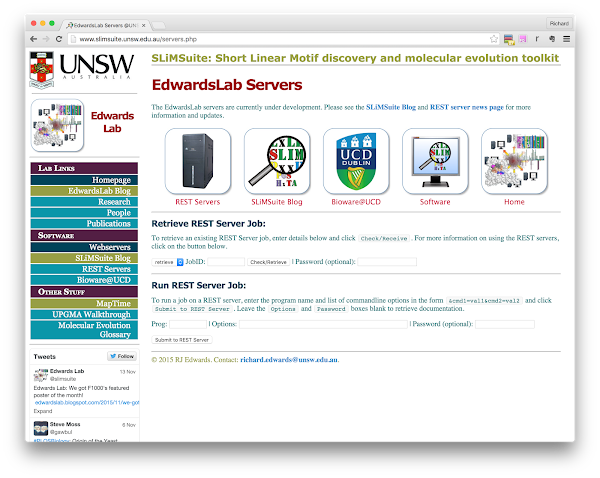
Data types and main input formats
From a computer science perspective, input and output for SLiMSuite is just plain ASCII text. This makes it easy to plug SLiMSuite into existing scripts and pipelines - and manually view/edit any input or output files if required. However, “plain text” is not very informative, and SLiMSuite actually deals with a lot of different formats of plain text (from a “human formatting” rather than “file type” point of view). The documentation is currently in the process of being updated to better reflect these formats but some commandline options will still simply list FILE, FILES or FILELIST as input parameters: see the accompanying descriptions to see what format these should be. Ask if it’s not clear! (File format documentation will also be added to the SLiMSuite blog, so check there.)
Within SLiMSuite, each file type has a distinct “file extension” that denotes the file type. Note that these are not enforced for input, although some programs may not always recognise the right format if a different extension is used. If you get odd input behaviour/errors that you do not understand, see if changing the file extensions helps. If you want a common file extension to be auto-recognised, let me know and I might be able to add it. SLiMSuite file extensions will not necessarily be recognised by other programs. NOTE: Operating systems will sometimes hide file extensions by default. If you are getting very confused, or have problems of extra *.txt extensions on everything, try changing the system settings. (And/or becoming familiar with command-line file manipulation.)
The main input formats for SLiM discovery are:
- A source of protein sequence data. This could be a protein FASTA file, a Uniprot plain text file, or a list of Uniprot accession numbers to download. For some tools, a single Uniprot accession number will work.
- A source of motif (regular expression) definitions. This is only required if looking for known (or other pre-defined) motifs and/or wanting to compare a set of de novo predictions with known motifs. A number of different formats are accepted for motif input, including SLiMFinder (summary) results and ELM downloads. The simplest/easiest is a plain text file of regular expressions. For more on motif regular expression formats, please see Edwards and Palopoli 2015.
Common motif discovery tasks
Jobs can be run and retrieved at: http://www.slimsuite.unsw.edu.au/servers.php. (This is a bit easier than making the URL directly, although this is also an option as we will see.)
NOTE: Some of the jobs take a while to run and the SLiMSuite servers have limited resources. It would therefore be useful if you could click on the example JobID links rather than trying to run every example REST command yourself. The first output tab (and the log tab) will show you the run times for that job, so you can see which jobs are fast or slow before you experiment.
Task 1: Find known SLiMs in a protein (ELM/SLiMProb)
ELM. Visit http://http://www.elm.eu.org/ and enter your protein of choice as Uniprot identifier or accession number in the box. (Identifiers will auto-complete and fill in some extra details.) For non-Uniprot protein sequences, you can also enter fasta format.
Try this now with P03070 (LT_SV40) or P03254 (E1A_ADE02). Each of them should have a True Positive LIG_Rb_LxCxE_1 motif.
SLiMProb. We can do a similar search using the SLiMProb REST server (paste the contents of the grey box onto the end of the http://rest.slimsuite.unsw.edu.au/ URL):
slimprob&uniprotid=E1A_ADE02&motifs=elm
JobID: 15120800029
NOTE: The ELM alias currently searches the 2015 ELM classes.
Task 2: Find custom SLiMS in a protein (SLiMProb)
slimprob&uniprotid=E1A_ADE02&motifs=LxCxE,PxDLS
JobID: 15120800031
Task 3: Finding proteome-wide occurrence of a motif using Bioware (SLiMSearch)
The SLiMSearch server is accessible at: http://slim.ucd.ie/slimsearch/. This has been recently updated to Version 4 and now brings in a lot of information, so it is recommended that you read the Help pages for the server.
Example (LIG_CtBP_PxDLS_1): http://slim.ucd.ie/rest/#/slimsearch/annotations?jobId=7R8Tvssm9HEdjWW7jQsgEHUfP0VlHdR6
Human protein PRDM16 is particularly interesting: it does not have an annotated ELM but does match a region annotated to interact with CTBP1. (See the Region column - Expand the instance Feature annotations for a clearer look.) This kind of search can be a good way of identifying new instances of known motifs - some of which may be in the literature but may not have yet made it into database annotation.
The ELM definition for this motif P[LVIPME][DENS][LM][VASTRG] is very degenerate with a lot of hits - over-prediction is a big problem in motif discovery. We can try to make the definition a little tighter as the expense of some instances, using another tool called SLiMMaker:
slimmaker&peptides=LIG_CtBP_PxDLS_1&iterate=T&align=F&minfreq=0.67&minseq=2
JobID: 15120600004
Repeating the SLiMSearch analysis with the redefined motif (P[EILMV][DN]L[ARST]) gives a greater density of known ELMs (see the Motif column) in the top ranked motifs: http://slim.ucd.ie/rest/#/slimsearch/annotations?jobId=L41BRpXQ1oTD6ByDuUSqjWbQZ22WBKbw.
Task 4: Predicting novel SLiMs de novo in a set of proteins (SLiMFinder)
SLiMFinder is designed to look for convergently evolved motifs that are shared between unrelated proteins. For example, we can look at the proteins known (in ELM) to contain the LIG_PCNA_PIPBox_1. As SLiMs are generally in disordered regions, we will switch disorder masking on with dismask=T, which uses IUPred to predict globular regions, which are masked out:
slimfinder&uniprotid=LIG_PCNA_PIPBox_1&dismask=T
JobID: 15120800001
(We will look at the UPC and motif cloud output among others.)
Task 5: Identifying known motifs from de novo predictions (CompariMotif)
When you have a lot of motif predictions, it can be tiresome and error-prone to manually scan them for things that look familiar. SLiMSuite has a tool called CompariMotif, which compares sets of motifs for similarity.
The comparimotif server can take motif files/lists (like SLiMProb or SLiMFinder output directly. These are given to the &motifs and/or &searchdb options: if no &searchdb is given then the input motifs are searched against themselves. (This can be useful if clouding goes a bit wrong.)
To pass the output of one server to another, use the format: &cmd=jobid:XXXXXX:OUTFMT, where XXXXXX is the Job ID and OUTFMT is the desired output format. E.g.:
comparimotif&motifs=jobid:15120800001:main&searchdb=LIG_PCNA_PIPBox_1
JobID: 15120900004
The server is currently in development so output is not sorted usefully yet. This is more of a problem if searching against many SLiMs:
comparimotif&motifs=jobid:15120800001:main&searchdb=elm
JobID: 15120900005
The best advice is to save the compare output table (retrieve&jobid=15120900005&outfmt=compare), open it up in Excel and sort on Score. Alternatively, use the CompariMotif server at http://bioware.ucd.ie.
Task 6: SLiM prediction with conservation masking (SLiMFinder)
Masking is important as it reduces the search space. It can also reduce the signal if it incorrectly masks some true positives but for larger datasets the reduction in "noise" can be more important. As well as dismask=T/F there are several other masking options in SLiMSuite:
- low complexity masking (
ONby default) - N-terminal methionines (
ONby default) - conservation-based masking (
OFFby default) - Uniprot feature masking (
OFFby default) - Motif masking (
OFFby default)
For custom sequence input, there is also the option for custom masking based on upper/lower case. For now, we will just look at conservation masking, as this has been shown to improve sensitivity in PPI data. For example, a 2013 compilation of CTBP1 interactors does not yield a significant motif:
slimfinder&uniprotid=CTBP1&dismask=T&runid=CtBP1-DisMask
JobID: 15120900002
But if consmask=T is also switched on:
slimfinder&uniprotid=CTBP1&dismask=T&consmask=T&runid=CtBP1-ConsMask
JobID: 15120900003
The importance of correcting for evolutionary relationships
The UPC correction can be switched off with efilter=F. Many motif prediction tools calculate estimated expectations without such correction. This can result is massive biases due to shared evolutionary history, which swamp any convergent SLiM evolution signal, for example with the LIG_CtBP_PxDLS_1 ELM proteins:
slimfinder&uniprotid=LIG_CtBP_PxDLS_1&dismask=T&runid=CtBP-NoEFilter&efilter=F
JobID: 15120800036
Task 7: Look for enrichment or depletion of motifs in a set of proteins (SLiMProb)
We can investigate why the PxDLS motif did not come back with just disorder masking by looking at its enrichment using SLiMProb. When given multiple proteins, SLiMProb will use the same UPC correction as SLiMFinder but also return statistics without UPC correction and simply treating all the sequences as one giant sequence. It can, for example, be used to investigate different definitions of a motif:
slimprob&uniprotid=CTBP1&dismask=T&runid=CtBP1-DisMask&motifs=PxDLS,P[LVIPME][DENS][LM][VASTRG],Px[DE][LM][ST]
JobID: 15120900016
In this case, we can see that even though the "true" motif has the most support, it is also expected to occur more by chance. It is enriched, but not enough to survive the multiple testing correction of SLiMChance.
Though not of interest here, the pUnd statistics can be used to look for depletion/avoidance of a particular motif in a dataset.
Task 8: Find novel motifs from a conservation pattern (SLiMPrints)
Patterns of evolutionary conservation can also be used to directly identify regions of proteins that look like motifs. The tool we have developed for this is called SLiMPrints, which can be run at the Bioware SLiMPrints server. For example, we can look for motif-like regions in one of the CtBP PPI partners, FOG1_HUMAN (Q8IX07): http://bioware.ucd.ie/~compass/biowareweb/cgi-bin/PHP_helper_files/slimprintsInfo.php?jobId=e7GZLf
This protein has a bunch of significant motif-like regions, including the PxDLS motif region at rank 7: http://bioware.ucd.ie/~proviz/ProViz/alignmentViewer/drawer.php?uniprotid=Q8IX07&slim=GPIDL&slimpos=793&column=794.5&width=80&collapse=false
(Note how the precise motif is rarely returned by de novo predictors.)
Task 9: Using the SLiMScape app to visualise a server job
We're now going to fire up Cytoscape and have a quick look at the SLiMScape app. This is fairly well described in the paper, so we will just look at the main ways to run the server. If you've not used Cytoscape before, you'll want to visit the Cytoscape website and watch the introduction video, before installing it.
The simplest is to retrieve an existing run:
- In the SLiMFinder tab, enter
15120900003in the Run ID box and hit Retrieve. - Apply the default layout.
- Explore the results. Connections are UPC relationships in the data.
Task 10: Running QSLiMFinder through SLiMScape
Now let's imagine we had seen the SLiMPrints results from above for FOG1_HUMAN and knew that it interacted with CtBP1. We could ask the specific question if any motifs in FOG1_HUMAN were enriched in the rest of the PPI dataset. We do this by using QSLiMFinder and giving Q8IX07 as the query. (&query=Q8IX07 on the server.)
First, add a node to the network and change its name to Q8IX07. Enter this in the Query Sequence box then highlight all of the nodes before hitting Run QSLiMFinder:
JobID: 15120900007
This is the essence of molecular mimicry and we could use the same approach to see if E1A_ADE02 shares any motifs by adding P03254 and using it as a query:
JobID: 15120900008
Task 11: Building PPI networks for analysis
The most useful thing of having access to SLiMSuite through Cytoscape is to be able to use it to explore PPI networks and select nodes for analysis. There are in-built tools to get PPI data into Cytoscape. For SLiMSuite, the ID must be a Uniprot ID or accession number, or a Node must have "Uniprot" attribute.
The SLiMSuite REST server also provides some methods for getting PPI data into Cytoscape (and/or for use on the server), using the PINGU server. This is still under development and so the documentation of the available PPI data is currently limited, but just get in touch if you want to use it. (Currently human only.)
PPI data is retrieved by entering one or more gene symbols as a &hublist, optionally along with a &ppisource (see the ppisource alias):
pingu&hublist=CTBP1,CTBP2&ppisource=intact
JobID: 15120900009
This can be used directly for &uniprotid input using the &rest=uniprot output:
slimfinder&uniprotid=jobid:15120900009:uniprot&dismask=T&consmask=T&runid=CtBP1and2
JobID: 15120900011
Alternatively, the PPI data can be imported into Cytoscape using the pairwise table:
- Start a new session. (Later you can workout how to import and merge networks.)
- Import network from URL: http://rest.slimsuite.unsw.edu.au/retrieve&jobid=15120900009&rest=pairwise
- Rename the
HubUniandSpokeUnifields tonameand attribute them toSource NodeandTarget Nodeattributes. MakeHubtheSource,SpoketheTargetandEvidencetheInteraction Typethen import. - Select the nodes that are shared interactors of both CtBP proteins.
- Modify the masking settings to include disorder, conservation and feature masking.
- Hit Run:
JobID: 15120900013
Subscribe to:
Posts (Atom)