Showing posts with label QSLiMFinder. Show all posts

Thursday, 10 December 2015

BioInfoSummer2015 SLiMSuite Workshop

Dr Richard Edwards, University of New South Wales
Thursday 10th December 2015

Session outline

Click for slides.
Part I: Theory

  • Introduction to workshop
  • What are SLiMs?
  • What is SLiMSuite

Part II: Practice

  • Installing/running SLiMSuite
  • Data types and main input formats
  • Motif discovery using the SLiMSuite REST Servers
  • Motif discovery using the SLiMScape app for Cytoscape

Additional help and documentation

General information about SLiMs and motif discovery can be found in the literature. Some good places to start are the recent ELM 2016 paper and our 2015 Methods in Molecular Biology review as well as the SLiMScape app paper:

For information about SLiMSuite, please visit the EdwardsLab webpage and the SLiMSuite blog. Help and documentation for the REST servers can also be found at the REST homepage. If in doubt, please email: richard.edwards@unsw.edu.au.

Several EdwardsLab publications also cover motifs and SLiMSuite tools.

Installing/Running SLiMSuite

NOTE: For this workshop, you do not need to install SLiMSuite. You will need Cytoscape and the SLiMScape app for the later parts.


The current SLiMSuite release is 2015-11-30 and can be downloaded by clicking the button (left).

In addition to the tarball available via the links above, SLiMSuite is now available as a GitHub repository (right).

See also: Installation and Setup.

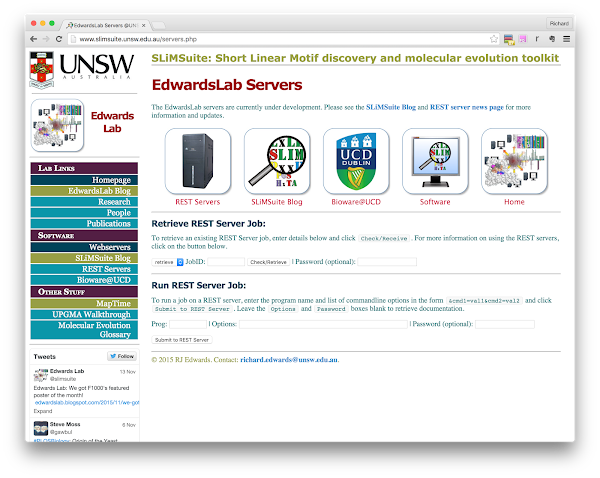
For this workshop, we will primarily be running the tools (and looking at pre-generated results) via the online servers:
Data types and main input formats

From a computer science perspective, input and output for SLiMSuite is just plain ASCII text. This makes it easy to plug SLiMSuite into existing scripts and pipelines - and manually view/edit any input or output files if required. However, “plain text” is not very informative, and SLiMSuite actually deals with a lot of different formats of plain text (from a “human formatting” rather than “file type” point of view). The documentation is currently in the process of being updated to better reflect these formats but some commandline options will still simply list FILE, FILES or FILELIST as input parameters: see the accompanying descriptions to see what format these should be. Ask if it’s not clear! (File format documentation will also be added to the SLiMSuite blog, so check there.)

Within SLiMSuite, each file type has a distinct “file extension” that denotes the file type. Note that these are not enforced for input, although some programs may not always recognise the right format if a different extension is used. If you get odd input behaviour/errors that you do not understand, see if changing the file extensions helps. If you want a common file extension to be auto-recognised, let me know and I might be able to add it. SLiMSuite file extensions will not necessarily be recognised by other programs. NOTE: Operating systems will sometimes hide file extensions by default. If you are getting very confused, or have problems of extra *.txt extensions on everything, try changing the system settings. (And/or becoming familiar with command-line file manipulation.)

The main input formats for SLiM discovery are:

  • A source of protein sequence data. This could be a protein FASTA file, a Uniprot plain text file, or a list of Uniprot accession numbers to download. For some tools, a single Uniprot accession number will work.
  • A source of motif (regular expression) definitions. This is only required if looking for known (or other pre-defined) motifs and/or wanting to compare a set of de novo predictions with known motifs. A number of different formats are accepted for motif input, including SLiMFinder (summary) results and ELM downloads. The simplest/easiest is a plain text file of regular expressions. For more on motif regular expression formats, please see Edwards and Palopoli 2015.

Common motif discovery tasks

Jobs can be run and retrieved at: http://www.slimsuite.unsw.edu.au/servers.php. (This is a bit easier than making the URL directly, although this is also an option as we will see.)

NOTE: Some of the jobs take a while to run and the SLiMSuite servers have limited resources. It would therefore be useful if you could click on the example JobID links rather than trying to run every example REST command yourself. The first output tab (and the log tab) will show you the run times for that job, so you can see which jobs are fast or slow before you experiment.


Task 1: Find known SLiMs in a protein (ELM/SLiMProb)

ELM. Visit http://http://www.elm.eu.org/ and enter your protein of choice as Uniprot identifier or accession number in the box. (Identifiers will auto-complete and fill in some extra details.) For non-Uniprot protein sequences, you can also enter fasta format.

Try this now with P03070 (LT_SV40) or P03254 (E1A_ADE02). Each of them should have a True Positive LIG_Rb_LxCxE_1 motif.

SLiMProb. We can do a similar search using the SLiMProb REST server (paste the contents of the grey box onto the end of the http://rest.slimsuite.unsw.edu.au/ URL):

slimprob&uniprotid=E1A_ADE02&motifs=elm

JobID: 15120800029

NOTE: The ELM alias currently searches the 2015 ELM classes.


Task 2: Find custom SLiMS in a protein (SLiMProb)

slimprob&uniprotid=E1A_ADE02&motifs=LxCxE,PxDLS

JobID: 15120800031


Task 3: Finding proteome-wide occurrence of a motif using Bioware (SLiMSearch)

The SLiMSearch server is accessible at: http://slim.ucd.ie/slimsearch/. This has been recently updated to Version 4 and now brings in a lot of information, so it is recommended that you read the Help pages for the server.

Example (LIG_CtBP_PxDLS_1): http://slim.ucd.ie/rest/#/slimsearch/annotations?jobId=7R8Tvssm9HEdjWW7jQsgEHUfP0VlHdR6

Human protein PRDM16 is particularly interesting: it does not have an annotated ELM but does match a region annotated to interact with CTBP1. (See the Region column - Expand the instance Feature annotations for a clearer look.) This kind of search can be a good way of identifying new instances of known motifs - some of which may be in the literature but may not have yet made it into database annotation.

The ELM definition for this motif P[LVIPME][DENS][LM][VASTRG] is very degenerate with a lot of hits - over-prediction is a big problem in motif discovery. We can try to make the definition a little tighter as the expense of some instances, using another tool called SLiMMaker:

slimmaker&peptides=LIG_CtBP_PxDLS_1&iterate=T&align=F&minfreq=0.67&minseq=2

JobID: 15120600004

Repeating the SLiMSearch analysis with the redefined motif (P[EILMV][DN]L[ARST]) gives a greater density of known ELMs (see the Motif column) in the top ranked motifs: http://slim.ucd.ie/rest/#/slimsearch/annotations?jobId=L41BRpXQ1oTD6ByDuUSqjWbQZ22WBKbw.


Task 4: Predicting novel SLiMs de novo in a set of proteins (SLiMFinder)

SLiMFinder is designed to look for convergently evolved motifs that are shared between unrelated proteins. For example, we can look at the proteins known (in ELM) to contain the LIG_PCNA_PIPBox_1. As SLiMs are generally in disordered regions, we will switch disorder masking on with dismask=T, which uses IUPred to predict globular regions, which are masked out:

slimfinder&uniprotid=LIG_PCNA_PIPBox_1&dismask=T

JobID: 15120800001

(We will look at the UPC and motif cloud output among others.)


Task 5: Identifying known motifs from de novo predictions (CompariMotif)

When you have a lot of motif predictions, it can be tiresome and error-prone to manually scan them for things that look familiar. SLiMSuite has a tool called CompariMotif, which compares sets of motifs for similarity.

The comparimotif server can take motif files/lists (like SLiMProb or SLiMFinder output directly. These are given to the &motifs and/or &searchdb options: if no &searchdb is given then the input motifs are searched against themselves. (This can be useful if clouding goes a bit wrong.)

To pass the output of one server to another, use the format: &cmd=jobid:XXXXXX:OUTFMT, where XXXXXX is the Job ID and OUTFMT is the desired output format. E.g.:

comparimotif&motifs=jobid:15120800001:main&searchdb=LIG_PCNA_PIPBox_1

JobID: 15120900004

The server is currently in development so output is not sorted usefully yet. This is more of a problem if searching against many SLiMs:

comparimotif&motifs=jobid:15120800001:main&searchdb=elm

JobID: 15120900005

The best advice is to save the compare output table (retrieve&jobid=15120900005&outfmt=compare), open it up in Excel and sort on Score. Alternatively, use the CompariMotif server at http://bioware.ucd.ie.


Task 6: SLiM prediction with conservation masking (SLiMFinder)

Masking is important as it reduces the search space. It can also reduce the signal if it incorrectly masks some true positives but for larger datasets the reduction in "noise" can be more important. As well as dismask=T/F there are several other masking options in SLiMSuite:

  • low complexity masking (ON by default)
  • N-terminal methionines (ON by default)
  • conservation-based masking (OFF by default)
  • Uniprot feature masking (OFF by default)
  • Motif masking (OFF by default)

For custom sequence input, there is also the option for custom masking based on upper/lower case. For now, we will just look at conservation masking, as this has been shown to improve sensitivity in PPI data. For example, a 2013 compilation of CTBP1 interactors does not yield a significant motif:

slimfinder&uniprotid=CTBP1&dismask=T&runid=CtBP1-DisMask

JobID: 15120900002

But if consmask=T is also switched on:

slimfinder&uniprotid=CTBP1&dismask=T&consmask=T&runid=CtBP1-ConsMask

JobID: 15120900003

The importance of correcting for evolutionary relationships

The UPC correction can be switched off with efilter=F. Many motif prediction tools calculate estimated expectations without such correction. This can result is massive biases due to shared evolutionary history, which swamp any convergent SLiM evolution signal, for example with the LIG_CtBP_PxDLS_1 ELM proteins:

slimfinder&uniprotid=LIG_CtBP_PxDLS_1&dismask=T&runid=CtBP-NoEFilter&efilter=F

JobID: 15120800036


Task 7: Look for enrichment or depletion of motifs in a set of proteins (SLiMProb)

We can investigate why the PxDLS motif did not come back with just disorder masking by looking at its enrichment using SLiMProb. When given multiple proteins, SLiMProb will use the same UPC correction as SLiMFinder but also return statistics without UPC correction and simply treating all the sequences as one giant sequence. It can, for example, be used to investigate different definitions of a motif:

slimprob&uniprotid=CTBP1&dismask=T&runid=CtBP1-DisMask&motifs=PxDLS,P[LVIPME][DENS][LM][VASTRG],Px[DE][LM][ST]

JobID: 15120900016

In this case, we can see that even though the "true" motif has the most support, it is also expected to occur more by chance. It is enriched, but not enough to survive the multiple testing correction of SLiMChance.

Though not of interest here, the pUnd statistics can be used to look for depletion/avoidance of a particular motif in a dataset.


Task 8: Find novel motifs from a conservation pattern (SLiMPrints)

Patterns of evolutionary conservation can also be used to directly identify regions of proteins that look like motifs. The tool we have developed for this is called SLiMPrints, which can be run at the Bioware SLiMPrints server. For example, we can look for motif-like regions in one of the CtBP PPI partners, FOG1_HUMAN (Q8IX07): http://bioware.ucd.ie/~compass/biowareweb/cgi-bin/PHP_helper_files/slimprintsInfo.php?jobId=e7GZLf

This protein has a bunch of significant motif-like regions, including the PxDLS motif region at rank 7: http://bioware.ucd.ie/~proviz/ProViz/alignmentViewer/drawer.php?uniprotid=Q8IX07&slim=GPIDL&slimpos=793&column=794.5&width=80&collapse=false

(Note how the precise motif is rarely returned by de novo predictors.)


Task 9: Using the SLiMScape app to visualise a server job

We're now going to fire up Cytoscape and have a quick look at the SLiMScape app. This is fairly well described in the paper, so we will just look at the main ways to run the server. If you've not used Cytoscape before, you'll want to visit the Cytoscape website and watch the introduction video, before installing it.

The simplest is to retrieve an existing run:

  1. In the SLiMFinder tab, enter 15120900003 in the Run ID box and hit Retrieve.
  2. Apply the default layout.
  3. Explore the results. Connections are UPC relationships in the data.

Task 10: Running QSLiMFinder through SLiMScape

Now let's imagine we had seen the SLiMPrints results from above for FOG1_HUMAN and knew that it interacted with CtBP1. We could ask the specific question if any motifs in FOG1_HUMAN were enriched in the rest of the PPI dataset. We do this by using QSLiMFinder and giving Q8IX07 as the query. (&query=Q8IX07 on the server.)

First, add a node to the network and change its name to Q8IX07. Enter this in the Query Sequence box then highlight all of the nodes before hitting Run QSLiMFinder:

JobID: 15120900007

This is the essence of molecular mimicry and we could use the same approach to see if E1A_ADE02 shares any motifs by adding P03254 and using it as a query:

JobID: 15120900008


Task 11: Building PPI networks for analysis

The most useful thing of having access to SLiMSuite through Cytoscape is to be able to use it to explore PPI networks and select nodes for analysis. There are in-built tools to get PPI data into Cytoscape. For SLiMSuite, the ID must be a Uniprot ID or accession number, or a Node must have "Uniprot" attribute.

The SLiMSuite REST server also provides some methods for getting PPI data into Cytoscape (and/or for use on the server), using the PINGU server. This is still under development and so the documentation of the available PPI data is currently limited, but just get in touch if you want to use it. (Currently human only.)

PPI data is retrieved by entering one or more gene symbols as a &hublist, optionally along with a &ppisource (see the ppisource alias):

pingu&hublist=CTBP1,CTBP2&ppisource=intact

JobID: 15120900009

This can be used directly for &uniprotid input using the &rest=uniprot output:

slimfinder&uniprotid=jobid:15120900009:uniprot&dismask=T&consmask=T&runid=CtBP1and2

JobID: 15120900011

Alternatively, the PPI data can be imported into Cytoscape using the pairwise table:

  1. Start a new session. (Later you can workout how to import and merge networks.)
  2. Import network from URL: http://rest.slimsuite.unsw.edu.au/retrieve&jobid=15120900009&rest=pairwise
  3. Rename the HubUni and SpokeUni fields to name and attribute them to Source Node and Target Node attributes. Make Hub the Source, Spoke the Target and Evidence the Interaction Type then import.
  4. Select the nodes that are shared interactors of both CtBP proteins.
  5. Modify the masking settings to include disorder, conservation and feature masking.
  6. Hit Run:

JobID: 15120900013

Monday, 7 December 2015

New SLiMSuite REST Servers

Since the move to UNSW in 2013, the Bioware SLiMSuite servers and REST servers have been undergoing some much needed TLC. As part of this process, a new set of UNSW REST servers were introduced and online with the 2015-06-01 SLiMSuite release.

An overview of how the REST servers work is given on the REST Homepage. The available tools are listed at the REST Tools page. The main ones - accessible through the SLiMScape app for Cytoscape are (or support):

The primary focus has been setting up new servers to be accessed via a RESTful-style interface whereby a URL can be directly given to the server and used to either download results directly (if accessing programmatically) or view in a web browser. As with the main programs, these servers use plain text inputs and outputs wherever. Whilst this probably makes proper computer scientists very unhappy, it should make it very easy to incorporate SLiMSuite REST functions into your own scripts - you only need to learn how to parse text. (It also makes it easy for me to swap input sources.) If you don’t want to write your own, SLiMParser is provided in the SLiMSuite download to do this for you.

The other design consideration that has gone into the REST servers is to make them run as much like the commandline versions as possible: (1) they use the same code; (2) they use the same commandline options, parsed from the URL. This means that (a) you should easily be able to reproduce server results on your own system, and (b) new functions (and bug fixes) should become quickly available via the REST servers.

To save the need for constructing complex URLs, there is a simple on-size-fits-all form at the EdwardsLab server page. Over time, tool-specific forms will be established. Currently, this only exists for SLiMMaker.

As ever, if something about the new servers misbehaves or does not make sense - or you really want some new functions - please get in touch.

Wednesday, 6 August 2014

SLiMSuite bug with combined sequence case and disorder masking

A small flaw has been discovered in the current implementation of disorder masking when it is combined with masking upper or lower case residues (casemask=X dismask=T). Rather than predicting disorder on the unmasked sequence and then combining with any case masking, disorder predictions are currently made on the masked sequences.

Hopefully, this will have minimal impact for the majority of cases. (Although I am not certain, I suspect that it will produce a tendency to over-predict disorder and thus under-mask.) This bug has been fixed for the next release of SLiMSuite. Note that other masking combinations are not affected.

Monday, 23 June 2014

New SLiMSuite release now available

A new download of SLiMSuite (release 2014-06-22) is now available.

As well as fixing the minor GOPHER output bug, a new Taxonomy processing module (rje_taxonomy) has been added. Although primarily designed for use with other SLiMSuite programs, this module has some standalone functionality for generating lists of Taxa IDs and species codes. (Details to follow.)

Output for the main SLiMSuite programs, SLiMFinder, SLiMProb and QSLiMFinder has also been consolidated and made more consistent for both re-running analyses and running analyses with multiple settings (consecutively) in the same directory. The use of GOPHER for generating alignments for conservation masking in these programs has also been improved to enable forking. (Details to follow.)

The final change of note is that SLiMMaker is now used to generate a consensus motif for each cloud returned by (Q)SLiMFinder. Note that (by default), these consensus motifs will not necessarily cover all occurrences in the cloud. (See SLiMMaker for more information.)

Other miscellaneous updates are listed below.

Updates since last release:

• gablam: Updated from Version 2.12.
→ Version 2.13: Fixed Protein vs DNA GABLAM. Modified sequence extraction to handle larger sequences. Add blastdir=PATH/.

• gopher: Updated from Version 3.3.
→ Version 3.4: Fixed FullRBH paralogue duplication issue.

• pingu_V4: Updated from Version 4.1.
→ Version 4.2: Bug fixes for use of PPISource to create PPI databases. Add HGNC to sourcedata (xrefdata=HGNC)

• qslimfinder: Updated from Version 1.7.
→ Version 1.8: Added cloudfix=T/F Restrict output to clouds with 1+ fixed motif (recommended) [False]. Consolidating output.

• slimbench: Updated from Version 2.2.
→ Version 2.2: Modified the FN/TN and ResNum calculations. No longer rate TP in random data as OT.
→ Version 2.3: Changed the default to queries=F. SearchINI bug fix. Added occbench generation.

• slimfarmer: Updated from Version 1.1.
→ Version 1.2: Implemented the slimsuite=T/F option and got SLiMFarmer qsub to work with GOPHER forking.

• slimfinder: Updated from Version 4.6.
→ Version 4.7: Added SLiMMaker generation to motif clouds. Added Q and Occ to Chance column.

• slimprob: Updated from Version 1.2.
→ Version 1.3: Consolidating output file naming for consistency across SLiMSuite. (SLiMBuild = Motif input)

• rje: Updated from Version 4.10.
→ Version 4.11: Enabled '\t#' comments in ini files. Modified getStrLC to return '' for 'none' by default. Added listMax().
→ Version 4.11: Added self.name() to basic object class.

• rje_blast: Reinstated for SLiMDisc legacy compatibility.

• rje_ensembl: Reinstated and updated.
→ Version 2.11: Added rje_taxonomy and makeuniprot=T/F. Removed metlist. Moved release and species data extraction.
→ Version 2.12: Changed chromspec to enable downloads of all species but also download toplevel files, not chromosomes.

• rje_hmm_V1: Reinstated.

• rje_hpc: Updated from Version 1.0.
→ Version 1.1: Disabled memory checking in Windows and OSX.

• rje_motif_V3: Updated from Version 3.0.
→ Version 3.1: Fixed minor code bugs.

• rje_obj: Updated from Version 1.6.
→ Version 1.7: Added self.name() to basic object class.

• rje_seq: Updated from Version 3.18.
→ Version 3.19: Fixed BLAST+ sequence extraction name truncation error.

• rje_seqlist: Updated from Version 1.4.
→ Version 1.5: Added sampler=N(,X) : Generate (X) file(s) sampling a random N sequences from input into seqout.N.X.fas [0]
→ Version 1.6: Modified currSeq() and nextSeq() slightly to fix index mode breakage. Look out for other programs breaking.
→ Version 1.6: Add sequence fragment extraction.

• rje_slim: Updated from Version 1.6.
→ Version 1.7: Fixed import slimFix(slim) error that was reporting slimProb()

• rje_slimcalc: Updated from Version 0.7.
→ Version 0.8: Made RLC the default.

• rje_slimcore: Updated from Version 1.14.
→ Version 1.15: Added pre-running GOPHER if no alndir and usegopher=T. Updated dataset() to use Input not Basefile.

• rje_taxonomy: Created/Renamed.
→ Version 0.0: Initial Compilation.
→ Version 0.1: Initial working version with rje_ensembl.
→ Version 1.0: Fully functional version with modified viral species code creation.

• rje_uniprot: Updated from Version 3.18.
→ Version 3.19: Updated and consolidated dbxref table generation (formerly linkout) using rje_db. Changed acc_num to accnum.

Tuesday, 3 December 2013

File management for large SLiMSuite runs

The latest release of SLiMSuite features a slight modification to the way that files are generated and tidied, which can be beneficial for large runs.

Previously, a different results directory (resdir=PATH) was required for each different run to avoid dataset-specific results being over-written. The partial exception was the *.pickle.gz file, which included some SLiMBuild information in its name. (This is predominantly to speed up the ability of (Q)SLiMFinder to recognise when an intermediate pickle file can be used or not.) As of the latest release, the RunID (runid=X) is also now included in dataset-specific output, allowing results from several different runs (with different RunIDs) to go into the same results directory.

The exception is the files that are created as part of the initial setup/SLiMBuild process: *.slimdb, *.dis.tdt and *.upc. From a given Dataset and RunID, the following files will therefore be generated in ResDir/

Dataset.RunID.cloud.txt
Dataset.RunID.mapping.fas
Dataset.RunID.maskaln.fas
Dataset.RunID.masked.fas
Dataset.RunID.motifaln.fas
Dataset.RunID.occ.csv
Dataset.dis.tdt
Dataset.#SLiMBuild-Text#.pickle.gz
Dataset.slimdb
Dataset.upc

Note that the default ResDir is SLiMFinder/, QSLiMFinder/ or SLiMProb and the default RunID is the date and time of the run.

TarGZ and SaveSpace

Obviously, the results directory can quickly fill up with files if there are multiple datasets and/or runs with different RunIDs. The way to get round this is to use the targz=T and savespace=X options.

targz=T will package up all of the files associated with a specific run into a single Dataset.RunID.tgz file. This does not work on Windows. (Note that previous versions generated a Dataset.tar.gz file.) The *.pickle.gz file associated with the run will not be included in the tar file unless savespace=2+ (see below).

Note: the tar file is actually generated from the run directory, not the results directory and will include the relative path to ResDir in the tarred files. This means that if you enter ResDir/ and then tar -xzf Dataset.RunID.tgz, an additional ResDir/ will be created in which the files can be found. This is actually pretty useful as it allows the user to unpack individual runs and then delete the whole directory when finished. To return individual results to their “rightful” place, simply run the tar command from the same directory that the SLiMSuite program was run from (e.g. tar -xzf ResDir/Dataset.RunID.tgz).

The savespace=X option saves space by deleting excess files. It is strongly recommended that this is used in conjunction with the targz=T. There are now four levels of savespace=X:

  • 0 = Delete no files
  • 1 = Delete all bar *.upc and *.pickle (Pickle excluded from tar.gz with this setting)
  • 2 = Delete all bar *.upc files (Pickle included in tar.gz with this setting)
  • 3 = Delete all dataset-specific files including *.upc and *.pickle (not *.tar.gz)

Another way to think of this is that 0 will delete nothing, 1 will leave enough files to rerun the same dataset/SLiMBuild combination, 2 will leave enough to run the same dataset with additional SLiMBuild settings, whilst 3 will cleanup absolutely everything.

The recommended setting for running on a cluster or supercomputer is targz=T savespace=1 unless file numbers are an issue, in which case targz=T savespace=2 would be better. targz=T savespace=3 is only really recommended when you are confident that all datasets will run to completion without issues. If there is a chance of nodes going down or walltimes being reached, it is better to keep the pickle files accessible for re-runs.

Sunday, 14 July 2013

SLiMSuite at the 3rd International Conference on Proteomics & Bioinformatics

If anyone is attending the 3rd International Conference on Proteomics & Bioinformatics this week then be sure to say hello. I am speaking on the last day in the “Computational Biology” track.. (Never the best time to talk at a conference as there is limited time for follow up but at least it is before lunch!)

SLiM Pickings: mining structural and sequence data for the prediction of short linear protein interaction motifs

Short Linear Motifs (SLiMs) are short functional protein sequences that act as ligands to mediate transient protein-protein interactions (PPI) in critical biological pathways and signaling networks. SLiMs are short (3-15aa), generally tolerate considerable sequence variation and typically have fewer than five residues critical for function. These features result in a degree of evolutionary plasticity not seen in domains and SLiMs often add new functions to proteins by convergent evolution. They also present a challenge for computational identification, making it difficult to differentiate biological signal from stochastic patterns. Despite this, discovering new SLiMs is of great interest due to their potential as therapeutic targets.

In recent years, we have made great progress in SLiM discovery, particularly through development of the SLiMSuite package of bioinformatics tools. SLiMs generally occur in structurally disordered regions of proteins and exhibit evolutionary conservation relative to other disordered residues. SLiMFinder uses this knowledge and exploits patterns of convergent evolution to predict novel, over-represented motifs within a statistical framework with high specificity. Applying this approach to a comprehensive set of human PPI data has highlighted interactome complexity and quality as the next challenges for SLiM prediction. Our latest development, QSLiMFinder (“Query” SLiMFinder) tackles some of these issues by incorporating specific interaction data to restrict the motif search space, which improves both the sensitivity and biological relevance of predictions. We are now using QSLiMFinder to combine structurally defined domain-motif interactions with large-scale PPI data to perform large-scale de novo SLiM prediction.

Tuesday, 30 April 2013

Second QSLiMFinder poster now on F1000 Posters

The second QSLiMFinder poster from the recent Cold Spring Harbor Laboratory "Systems Biology: Networks" meeting is now available at F1000 Posters:
  • Edwards RJ & Palopoli N. Computational prediction of short linear motifs mediating host-pathogen protein-protein interactions.
  • (I'm not sure why the last post about the other poster disappeared for a few days but it's back now!

    Friday, 19 April 2013

    Latest QSLiMFinder poster now on F1000 Posters

    One of the QSLiMFinder posters from the recent Cold Spring Harbor Laboratory "Systems Biology: Networks" meeting is now available at F1000 Posters:
  • Palopoli N & Edwards RJ. Improved computational prediction of Short Linear Motifs using specific protein-protein interaction data.
  • With any luck, the other one will appear soon.

    Friday, 29 March 2013

    QSLiMFinder at Cold Spring Habor Laboratory "Systems Biology: Networks" 2013

    This month saw another successful "Systems Biology: Networks" meeting held at Cold Spring Habor Laboratory, New York. SLiMSuite was well represented with two posters, which you can now view online if you like:

    1. Palopoli N & Edwards RJ. Improved computational prediction of Short Linear Motifs using specific protein-protein interaction data.
    Short Linear Motifs (SLiMs) are short segments of proteins that mediate numerous domain-motif interactions (DMI). In spite of the crucial role that they play in many biological pathways, their features and diversity remain understudied. The limited size and degenerate nature of SLiMs hinder their identification by pure de novo prediction methods, which must deal with a very large motif search space entirely determined by the parameters used to build the motifs.

    The most successful methods are built on an explicit model of convergent evolution for detecting over-represented motifs in unrelated proteins that share a common attribute. We have previously presented SLiMFinder[1] which accounts for the motif search space to statistically model the probability of observing a given prediction by chance. SLiMFinder greatly benefits from the incorporation of prior knowledge that reduces the sequence search space and increases sensitivity.

    More recently we have extended the standard algorithm to develop QSLiMFinder, a query-focused method of SLiM discovery. In QSLiMFinder the search space is not built from the whole set of proteins but rather from one specific query protein or region thereof. By only looking at all putative motifs in the query that may be shared by the rest, the motif space is significantly reduced and the sensitivity is increased. Moreover, DMI data can be used to focus on a specific query region rather than in the complete protein. A major plus of QSLiMFinder is its ability to incorporate this information from three-dimensional structures of interacting proteins, like those in the database of 3D Interaction Domains (3DID)[2] or as predicted from structural data[3].

    A thorough comparative benchmark of the SLiMFinder and QSLiMFinder performances on datasets of known motifs has confirmed that the latter typically returns motifs with higher significance and produces more results that are enriched against expectation. As expected, QSLiMFinder improves sensitivity by ‘zooming-in’ in the region of interest and paves the way to mine interaction data for novel SLiMs.
    1. Edwards RJ, Davey NE, Shields DC. (2007) SLiMFinder: a probabilistic method for identifying over-represented, convergently evolved, short linear motifs in proteins. PLoS One; 2(10):e967.
    2. Stein A, Ceol A, Aloy P. (2011) 3did: identification and classification of domain-based interactions of known three-dimensional structure. Nucleic Acids Res; 39:D718-723.
    3. Stein A, Aloy P. (2010) Novel peptide-mediated interactions derived from high-resolution 3-dimensional structures. PLoS Comput Biol. 6(5):e1000789.

    2. Edwards RJ & Palopoli N. Computational prediction of short linear motifs mediating host-pathogen protein-protein interactions.
    Short Linear Motifs (SLiMs) are short functional protein sequences that act as ligands to mediate transient protein-protein interactions (PPI) in critical biological pathways and signaling networks. SLiMs are short (3-15aa), generally tolerate considerable sequence variation and typically have fewer than five residues critical for function. These features result in a degree of evolutionary plasticity not seen in domains and SLiMs often add new functions to proteins by convergent evolution. This is particularly prevalent in viruses, which often exploit SLiMs to manipulate the molecular machinery of host cells[1].

    In recent years, the numbers of tools and algorithms for SLiM discovery has increased dramatically. Of these, SLiMFinder[2], which exploits a statistical model of convergent evolution to predict novel over-represented motifs with high specificity, repeatedly performs well in comparative studies. The size and degeneracy of SLiMs presents a challenge for computational identification, making it difficult to differentiate biological signal from stochastic patterns. SLiMs generally occur in structurally disordered regions of proteins and exhibit evolutionary conservation relative to other disordered residues, which can be exploited by SLiMFinder to reduce the sequence search space and improve predictions. We have recently developed QSLiMFinder (“Query SLiMFinder”), an extended version of the algorithm that can incorporate specific interaction data to restrict the motif search space and improve both the sensitivity and biological relevance of predictions. Whereas SLiMFinder can ask the general question of which motifs are enriched in a set of proteins that interact with a common partner[3], QSLiMFinder can specifically ask which of the motifs present in a viral protein are enriched in the set of host proteins that interact with the same host partner. By applying this to combined interactomes of host-host and host-pathogen PPI, it should be possible to identify novel candidates for viral mimicry of host SLiMs.

    1. Davey NE, Travé G, Gibson TJ (2011) How viruses hijack cell regulation. Trends Biochem. Sci. 36 (3): 159–69.
    2. Edwards RJ, Davey NE, Shields DC. (2007) SLiMFinder: a probabilistic method for identifying over-represented, convergently evolved, short linear motifs in proteins. PLoS One; 2(10):e967.
    3. Edwards RJ, Davey NE, O'Brien K & Shields DC (2012): Interactome-wide prediction of short, disordered protein interaction motifs in humans. Molecular Biosystems 8: 282-95.

    Friday, 21 December 2012

    New SLiMSuite, SeqSuite and RJESuite downloads available

    Just in time for Christmas, new releases of all the downloads are available at the Edwards Lab software page. Documentation is still lagging behind but will hopefully catch up (along with a bit of an overhaul of this blog). Questions welcome in the meantime.

    In addition to QSLiMFinder 1.4, the biggest change this release is probably the upgrade of GOPHER. Version 3.x features improved organisation of output files for queries from different species in addition to a capacity to have several different multiple alignment programs run on the same orthologue sets. See the website for more info.

    Updates since last release:

    • gopher: Created.
    → Version 3.0: See archived GOPHER 1.9 and gopher_V2 2.9 for history and obselete options.
    → Version 3.0: Added organise=T/F and gopherdir=PATH for improved file organisation. Tightened savespace.
    → Version 3.0: Added compfilter=T/F for improved complexity filter and composition statistics control for *initial* BLAST.
    → Version 3.0: Changed default tree extension to *.nwk for compatibility with MEGA. Deleted _phosAlign() method.
    → Version 3.0: Added orthology ID option and alignment program to customise output further.
    → Version 3.1: Added full reciprocal best hit method. (fullrbh=T/F)

    • gopher_V2: Updated from Version 2.8.
    → Version 2.9: Deleted oldStigg() method. Added simple Reciprocal Best Hit orthology prediction.

    • qslimfinder: Updated from Version 1.2.
    → Version 1.3: Updated the output for Max/Min filtering and the pickup options.
    → Version 1.4: Added additional dictionary and list to store Query dimers and SLiMs for motif space calculations.
    → Version 1.4: Added qexact=T/F option for calculating Exact Query motif space (True) or estimating from dimers (False).

    • slimfinder: Updated from Version 4.2.
    → Version 4.3: Updated the output for Max/Min filtering and the pickup options. Removed TempMaxSetting.
    → Version 4.4: Modified to work with GOPHER V3.0.

    • rje: Updated from Version 4.3.
    → Version 4.4: Added lineFromIndex(target,file,re_index='^(\S+)\s',sortunique=False,xreplace=True).

    • rje_seq: Updated from Version 3.13.
    → Version 3.14: Added CLUSTAL Omega alignment program ['clustalo']
    → Version 3.15: Added PAGAN alignment program ['pagan'] and (hopefully) fixed minor Windows fastacmd bug.

    • rje_sequence: Updated from Version 2.1.
    → Version 2.2: Added more yeast species.

    • rje_slimcalc: Updated from Version 0.4.
    → Version 0.5: Altered to use GOPHER V3 and handle nested alignment directories.

    • rje_slimlist: Updated from Version 1.0.
    → Version 1.1: Modified to work with GOPHER V3.0 for alignments.

    Wednesday, 28 November 2012

    QSLiMFinder 1.4: quicker and more efficient - available on request

    The on-going benchmarking of QSLiMFinder has thrown up a couple of discoveries to date. The first is that, reassuringly, it appears to work. (More on this another time.) The second is that it is slow. Or, at least, it was slow.

    Thankfully, the cause of its surprisingly slow performance (compared to SLiMFinder) has been tracked down and fixed. At the same time, a (related) potential memory issue with large query sequences has also been sorted out.

    The underlying problem is unlikely to have had a large effect on the SLiM prediction itself, although this is currently under investigation. The last release of SLiMSuite was only last week and, as QSLiMFinder is not officially published and released yet, I will not be compiling a new download immediately to take advantage of the improvements. The revised code is available on request if anyone is using QSLiMFinder.

    Saturday, 24 November 2012

    New SLiMSuite, SeqSuite and RJESuite releases are now available

    New releases of SLiMSuite, SeqSuite and RJESuite are now available from the Edwards Lab software page.

    Please note that the documentation (particularly the manuals) are still lagging a bit behind, so do report anything that does not make sense. The default settings also need to be verified as there is a chance that some of these may have inadvertently changed over the years. (The same core code is now used for the webservers, which often have different defaults.) Checking these along with updating and checking the servers themselves are ongoing priorities.

    A full list of updated modules is given below. As well as SLiMMaker now handling end of sequence characters, the biggest changes this release are updates to CompariMotif to (3.7) output unmatched input motifs and (3.8) improve handling of partially overlapping ambiguous positions (e.g. [AGS] and [ST]). The motivation behind both these changes is the ongoing benchmarking (and preparation for publication) of QSLiMFinder and the creation of SLiMBench for benchmarking motif prediction methods. A QSLiMFinder section has been added to the SLiMFinder Manual (section 5.4). SLiMBench is still a work in progress and will be documented in a later release.

    Updates since last release:

    • comparimotif_V3: Updated from Version 3.6.
    → Version 3.7: Added coreIC and output of unmatched motifs.
    → Version 3.8: Added overlaps=T/F : Whether to include overlapping ambiguities (e.g. [KR] vs [HK]) as match [True]
    → Version 3.8: Changed scoring of overlapping ambiguities - uses IC of all possible ambiguities. Added "Ugly" match type.

    • slimbench: Created.
    → Version 0.0: Initial Compilation.
    → Version 0.1: Functional version with benchmarking dataset generation.
    → Version 1.0: Consolidation of "working" version with additional basic benchmarking analysis.
    → Version 1.1: Added simulated dataset construction and benchmarking.
    → Version 1.2: Added MinIC filtering to benchmark assessment. Sorted beginning/end of line for reduced ELMs.
    → Version 1.3: Made SimCount a list rather than Integer. Sorted CompariMotif assessment issue.
    → Version 1.4: Added ICCut and SLiMLenCut as lists and output columns.
    → Version 1.5: Added Summary Results output table. Removed PropRes.

    • slimmaker: Updated from Version 1.0.
    → Version 1.1: Modified to work with end of line characters.

    • slimsearch: Updated from Version 1.5.
    → Version 1.6: Minor tweaks to Log output. Add option for UPC number in occ output.

    • rje: Updated from Version 4.1.
    → Version 4.2: Modified INI reading across the board to look in ../settings/ and look for defaults.ini as well as rje.ini.
    → Version 4.2: Enabled handing on -ini FILE in addition to ini=FILE.
    → Version 4.3: Added ilist and nlist types to cmdRead for objects. (Lists of integers and floats). Add ratio() function.

    • rje_blast: Updated from Version 1.13.
    → Version 1.14: Added blast.checkProg(qtype,stype) to check whether blastp setting matches sequence formats.

    • rje_db: Created.
    → Version 0.0: Initial Compilation.
    → Version 0.1: Added merge tables option.
    → Version 0.2: Miscellaneous updates to various methods.
    → Version 0.3: Minor doc tweaks and added keepFields().

    • rje_seq: Updated from Version 3.12.
    → Version 3.13: Updated sequence type checking for use with GABLAM 2.10.

    • rje_seqlist: Created.
    → Version 0.0: Initial Compilation. Based on rje_seq 3.10.
    → Version 0.1: Added basic species filtering and sequence output.
    → Version 0.2: Added upper case filtering.
    → Version 0.3: Added accnum filtering and sequence renaming.
    → Version 0.4: Added sequence redundancy filtering.
    → Version 0.5: Added newgene=X for sequence renaming (newgene_spcode__newaccXXX). NewAcc no longer fixed Upper Case.
    → Version 1.0: Upgraded to "ready" Version 1.0. Added concatenate=T and split=X options for sequence concatenation.
    → Version 1.0: Added reading of sequence type from rje_seq.py and mixed=T/F.
    → Version 1.1: Added shortName() and modified SeqDict.

    • rje_sequence: Updated from Version 2.0.
    → Version 2.1: Added re_unirefprot = re.compile('^([A-Za-z0-9\-]+)\s+([A-Za-z0-9]+)_([A-Za-z0-9]+)\s+')

    • rje_slim: Updated from Version 1.5.
    → Version 1.6: Fixed splitting bug introduced by lower case motifs.

    • rje_slimcore: Updated from Version 1.8.
    → Version 1.9: Minor modifications to Log output. Updated motifSeq() function to output unmasked sequences.

    • rje_slimlist: Updated from Version 0.6.
    → Version 1.0: Functional module with lower case motif splitting fixed and ? -> .{0,1} replacement.

    • rje_zen: Updated from Version 1.0.
    → Version 1.1: Added a few more words here and there.

    Tuesday, 15 May 2012

    Bioinformatics Postdoc Position available!

    A two-year BBSRC-funded postdoc position is now available to work in the Edwards lab developing and applying QSLiMFinder. Informal enquiries are encouraged. You can apply or get further details here. The blurb:
    You are invited to apply for the post of Research Fellow to work closely with Dr Richard Edwards on a BBSRC-funded project to develop and apply computational tools for the prediction of protein motifs that mediate protein-protein interactions.

    Many protein-protein interactions are mediated by Short Linear Motifs (SLiMs): short stretches of proteins (5-15 amino acids long), of which only a few positions are critical to function. These motifs are vital for biological processes of fundamental importance, such as signalling pathways and targeting proteins to the correct part of a cell.

    This position represents an exciting opportunity to join one of the early pioneers in the growing field of SLiM prediction. The primary objective of this project is to integrate a number of leading computational techniques to predict novel SLiMs and, in so doing, add crucial detail to protein-protein interaction networks. This will generate a valuable resource of potential SLiMs, including defined occurrences and interactions.

    The project will use a number of computational and sequence analysis techniques. Basic programming skills are essential. Experience with database design, HPC and web programming are desirable. You will be required to develop a thorough knowledge of SLiM-mediated protein-protein interactions and should therefore be comfortable with biological literature, biochemistry, molecular evolution and structural biology.

    A background in either computer science or biology, with a PhD in a relevant subject area, is essential. Previous research experience (PhD or Postdoctoral) in computational biology is highly desirable. Candidates with a computer science background must demonstrate an interest and aptitude for molecular biology. Similarly, candidates with a biology background must demonstrate an interest and aptitude for computer programming.

    You should be an enthusiastic researcher, a good team-worker and an excellent communicator. Project management skills and independent research experience are desirable.

    The position is full-time and available immediately for a period of up to two years.

    The closing date for this position is 15 June 2012. Please apply online through www.jobs.soton.ac.uk or alternatively telephone 023 8059 2750 for an application form. Please quote reference number 119512BJ on all correspondence. In addition to submitting your CV, please enclose a personal statement highlighting your research interests and experience, as outlined in the accompanying Further Particulars. Please note that the project is 100% computational.

    Wednesday, 9 May 2012

    SLiMSuite servers and programs

    An emerging field of biology is the role of intrinsically disordered regions in protein function and, specifically, protein-protein interactions (PPI) [1-2]. Of particular interest, Short, Linear Motifs (SLiMs) playing a vital role in disorder-mediated PPI, acting as ligands for molecular signalling, post-translational modifications and subcellular targeting [3]. SLiMs have extremely compact protein interaction interfaces, generally encoded by less than 4 major affinity-/specificity-determining residues within a stretch of 2-10 residues [4]. Their small size enables high functional density and evolutionary plasticity, which is frequently exploited by rapidly evolving pathogens that use them to hijack cellular processes [5]. These same features also make experimental discovery a challenge and considerable attention has therefore been given to computational methods for SLiM prediction and analysis [6].

    A number of these tools have been developed by the Edwards and Shields labs [7-11] and made available as part of the SLiMSuite package and online as webservers (http://bioware.ucd.ie) [9-10,12-14], with two new tools, SLiMPrints and QSLiMFinder, currently in preparation for submission, and SLiMMaker to be added soon. The main tools that form the SLiMSuite package/servers are as follows:
    • SLiMFinder [8,13]: de novo SLiM prediction based on a statistical model of over-represented motifs in unrelated proteins.
    • SLiMDisc [7,12]: de novo SLiM prediction based on heuristic ranking of over-represented motifs in unrelated proteins.
    • SLiMPred [11]: de novo SLiM/MoRF prediction in single proteins based machine learning of motif attributes.
    • SLiMSearch [10]: biological context (disorder & conservation) for searches of pre-defined motifs with under- and over-representation statistics, correcting for evolutionary relationships.
    • SLiMSearch 2.0 [14]: biological context (disorder & conservation) and ranking for proteome-wide searches of pre-defined motifs.
    • SLiMPrints (in prep.): de novo SLiM/MoRF prediction in single proteins from statistical clustering of conserved disordered residues.
    • QSLiMFinder (server coming soon): Query-based variant of SLiMFinder with increased sensitivity and specificity.
    • CompariMotif [9]: Motif-motif comparison tool.
    • SLiMMaker (coming soon): Simple tool for converting aligned peptides or SLiM occurrences into a regular expression motif.
    • GOPHER [12]: Automated orthologue prediction and alignment algorithm. Used for conservation-based masking (SLiMFinder/SLiMSearch) and prediction (SLiMPrints).
    • GABLAM [7] (server coming soon): BLAST-based protein similarity scoring and clustering. Used for SLiMFinder and SLiMSearch adjustments for evolutionary relationships.
    Personnel (and funding applications) permitting, a number of improvements for these resources are planned, including updates to the underlying databases for proteome-wide predictions (SLiMSearch 1.0 & 2.0), conservation analyses (SLiMSearch 1.0 & 2.0, SLiMPrints, GOPHER) and SLiM comparisons (CompariMotif). We also intend to improve the integration of different tools, allowing seamless continuation of analyses. Motif predictions ((Q)SLiMFinder/SLiMPrints/SLiMPred) will be able to be searched directly against known motifs (CompariMotif) or proteomes (SLiMSearch); GOPHER alignments will be accessible for SLiMPrints analyses and even SLiMSearch/(Q)SLiMFinder input; outputs of motif occurrences ((Q)SLiMFinder/SLiMSearch) can be used to redefine motifs using SLiMMaker etc. If you have any other suggestions for improvements, please let us know.


    References:
    [1] Tompa P (2011) Unstructural biology coming of age. Curr Opin Struct Biol 21: 419; [2] Babu MM et al. (2011) Intrinsically disordered proteins: regulation and disease. Curr Opin Struct Biol 21:432; [3] Diella F et al. (2008) Understanding eukaryotic linear motifs and their role in cell signaling and regulation. Front Biosci 13:6580; [4] Davey NE et al. (2012) Attributes of short linear motifs. Mol Biosyst 8:268; [5] Davey NE, Trave G & Gibson TJ (2011) How viruses hijack cell regulation. Trends Biochem Sci 36:159; [6] Davey NE, Edwards RJ & Shields DC (2010) Computational identification and analysis of protein short linear motifs. Front Biosci 15:801; [7] Davey NE, Shields DC & Edwards RJ (2006): SLiMDisc: short, linear motif discovery, correcting for common evolutionary descent. Nucleic Acids Res. 34:3546; [8] Edwards RJ, Davey NE & Shields DC (2007): SLiMFinder: A probabilistic method for identifying over-represented, convergently evolved, short linear motifs in proteins. PLoS ONE 2:e967; [9] Edwards RJ, Davey NE & Shields DC (2008): CompariMotif: Quick and easy comparisons of sequence motifs. Bioinformatics 24:1307; [10] Davey NE et al. (2010): SLiMSearch: a webserver for finding novel occurrences of short linear motifs in proteins, incorporating sequence context. Lecture Notes in Bioinformatics 6282:50; [11] Mooney C et al. (2012): Prediction of short linear protein binding regions. J Mol Biol 415:193; [12] Davey NE, Edwards RJ & Shields DC (2007): The SLiMDisc server: short, linear motif discovery in proteins. Nuc Acids Res 35:W455; [13] Davey NE et al. (2010): SLiMFinder: a web server to find novel, significantly over-represented, short protein motifs. Nuc Acids Res 38:W534; [14] Davey NE et al. (2011): SLiMSearch 2.0: biological context for short linear motifs in proteins. Nuc Acids Res 39:W56.